Commercial Lighting Control Troubleshooting Guide
At Kord Electric, we approach problems with commercial lighting like we would approach a breaker that is acting up: calm hands, careful checks, and the right order of steps. That is why our Commercial Lighting Control Troubleshooting Guide starts with the basics, then moves into the deeper causes that actually stop the lights from behaving. In the guide, we tell our customers to verify power and input signals first, check sensor coverage next, and confirm that the control logic matches the building schedule. Then we follow the chain until the issue makes sense, not until we just guess. And yes, we have seen more than one site where the system was “fine” while the installer’s laptop was unplugged. Even the smartest tech tools cannot outsmart a missing cable.
Below, our expert service team explains the most common issues we see in commercial and industrial facilities and how we fix them with clear, repeatable steps. And we do it in plain language, not in the kind of jargon that sounds like it was written by a sleep-deprived robot.
1) Why commercial lighting controls fail in the first place
In major property buildings, lighting controls carry a lot of responsibility. They manage occupancy, daylight response, schedules, dimming levels, and sometimes emergency behavior. However, controls fail for predictable reasons. Often it starts with mismatched components, especially when a retrofit mixes old drivers with newer sensors. Additionally, we frequently find programming rules that do not match the way the space is actually used. For example, if a loading dock gets door traffic at odd hours, but the schedule assumes steady occupancy, the system will treat the space like it is empty.
Next, we see drift and wear over time. Sensors can become misaligned after maintenance work. Network connections can degrade. Relay contacts can wear. And in some cases, the control panel gets updated by well meaning staff, but the lighting zone mapping is not corrected. That is why our technicians work with a step by step mindset, instead of flipping switches and hoping the building gods approve.
2) Lights do not turn on or stay on: the power and signal check
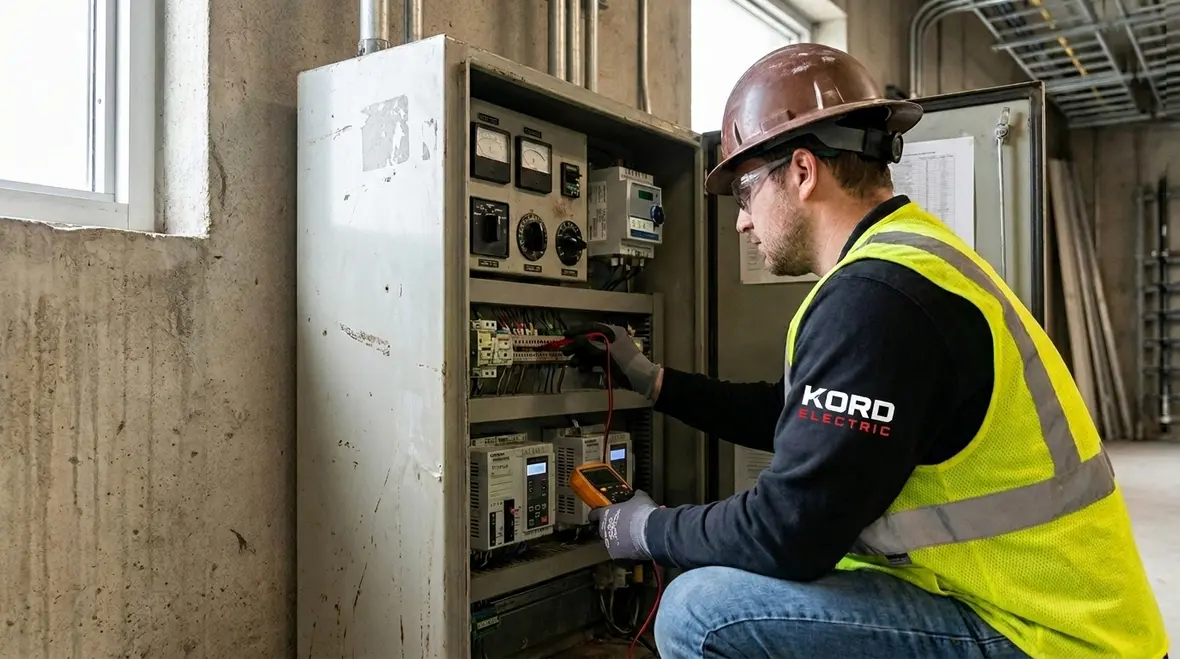
When lighting controls refuse to switch, we treat it like a troubleshooting relay race. One failure stops the entire line. Therefore, our first move is to confirm incoming power and correct control voltage at the panel and at the device level. We also verify that the correct circuit and zone mapping are active. Then we check the control signal path, including any occupancy sensor inputs, manual wall stations, and network gateways where applicable.
In many commercial settings, the issue is not the lights. It is the control input. We have walked into facilities where the sensor status looked “on” in the UI, yet the output never energized because the dimming driver expected a different control type. In addition, we sometimes find that bypass switches are stuck, or that a relay output is configured to normally off while the field wiring is set for normally on. That mismatch can make a system appear haunted.
Our expert service staff explains what we find as we test, because in our experience, the fastest fixes happen when the building team understands the logic. We show what the system is reading, what it believes, and where that belief diverges from real life.
3) Dimming and brightness jumps: drivers, calibration, and sensor placement
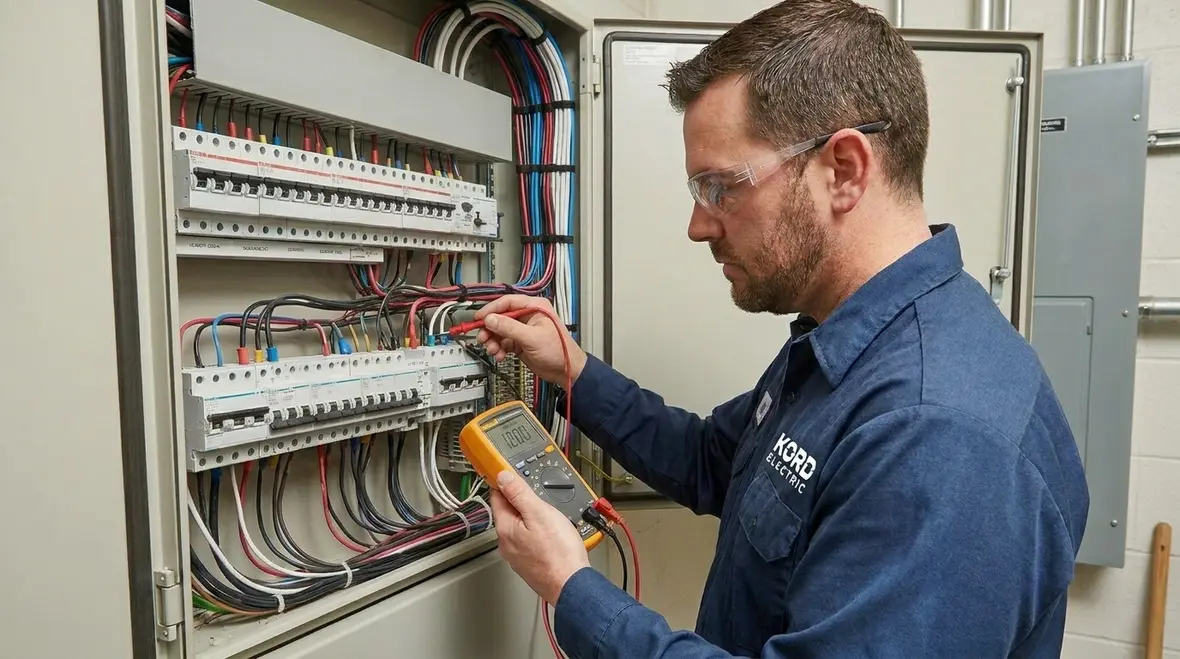
If your lights dim one way and behave another way, the problem usually lives in the interaction between sensors, drivers, and programmed levels. First, we confirm compatibility between dimming modules and the lighting load. Then we examine minimum and maximum dimming settings. Many control systems require specific ranges to prevent flicker and unwanted jumps.
Next, we check calibration. Occupancy sensors and daylight sensors need correct thresholds and time delays. For example, if a daylight sensor sees a bright area at startup, it may drive the lights down hard and then bounce back when clouds pass. Likewise, sensor placement matters. If furniture layout, ceiling obstructions, or new partitions block the sensor view, the system will interpret occupancy incorrectly. In warehouses and manufacturing spaces, we pay close attention to airflow fans and reflective surfaces because they can trick sensors into unstable readings.
Our technicians also look at wiring runs and ground integrity. Loose connections can create noisy signals. And in modern commercial and industrial builds, a “small” wiring issue can become a “big” brightness issue once the control panel starts pulsing levels.
4) Schedules run at the wrong time: time settings, holidays, and overrides
Another frequent issue we handle involves schedules. Lights that come on early, shut off too soon, or fail during holidays usually trace back to time settings, schedule profiles, and override logic. Therefore, we verify the control controller time, daylight saving adjustments, and time zone configuration. Then we inspect facility calendars for holiday and special event schedules.
After that, we look at overrides. Many systems allow manual overrides at wall stations or through building automation. If those overrides are not cleared, the system can ignore scheduled behavior until a reset occurs. We also confirm that occupancy based rules do not conflict with schedule based rules. For example, if the space uses both a time schedule and an occupancy sensor strategy, the priorities must be clear. Otherwise, the controller may treat “occupied” as a short burst while the schedule says “off,” leading to a cycle that feels like the lights are indecisive.
We explain these items in a steady, practical way. Our goal is not just repairs. It is making sure the staff can predict what the system will do tomorrow, not only what it did yesterday.

5) Sensors show motion but lights do nothing: zone mapping and occupancy logic
At some commercial and industrial facilities, sensors report motion properly but the lights remain off or dim to a fixed level. When that happens, we check zone mapping first. A sensor can be physically installed correctly and still be assigned to the wrong lighting zone in software. Additionally, the occupancy logic might require a second condition. Some setups require both occupancy and a time window, or occupancy and a minimum daylight condition. If one condition is not met, the output stays limited.
Then we inspect delay and hold time settings. In areas like conference rooms, corridors, and staff rooms, short delays can make it seem like the system “ignores” motion. For warehouses, long delays can cause energy waste. Our technicians tune these parameters based on actual use patterns, which means we often ask building staff about peak activity times and movement patterns, not just “what the room is for.”
We also check for sensor health indicators. Some sensors can fail in a way that still shows “active” status but cannot read signal strength correctly. When that occurs, we test the sensor output at the device level, not just in the interface.
6) Network and panel faults: when connectivity breaks the control chain
Modern commercial lighting controls often rely on panels, gateways, and networks. Therefore, connectivity issues can interrupt commands even when sensors and drivers work. We address this by checking communications health, verifying controller firmware versions, and reviewing network settings. If a gateway drops packets, the controller may not receive valid updates in time. Then lights stop following schedules or fail to respond to occupancy events.
Our expert service staff also checks for power quality and surge events. In large buildings, electrical transients can damage communication components. That is why we pay attention to cabinet health, fan operation in control enclosures, and correct termination. Then we confirm that the controller is using the correct application logic for the lighting loads.
To make the fix stick, we document the changes we make. So others in the facility team do not need to guess what happened last week like it is a clue from a mystery show. And speaking of mystery, yes, we have seen the same problem appear after an unrelated building network update. It is never random. It is usually configuration drift.
7) How we handle troubleshooting for major property buildings
Kord Electric works with commercial and industrial facilities, and we expect higher complexity. That means we follow a systematic method rather than scattered fixes. First, we identify the complaint and isolate whether it affects one zone or the whole system. Then we run checks in a logical order: power, wiring, device health, control mapping, and programming logic. Only after that do we adjust sensor thresholds, dimming curves, or schedule rules.
In addition, we involve the building stakeholders early. Our technicians explain what each test confirms, and we share what needs to change. We also provide an action plan for follow up, so the facility does not return to “reactive maintenance mode.”
For a quick look at how our process typically aligns with the most common failure types, we sometimes use a two track approach during on site review.
Common issue
Lights not switching
Dimming jumps or flicker
Schedule errors
Sensor activity but no output
Typical first fix step
Confirm power and zone mapping
Verify driver compatibility and calibration
Check time, calendar, and overrides
Validate occupancy logic and zone assignment
For facility teams planning a full upgrade or trying to make sense of current standards, pairing this Commercial Lighting Control Troubleshooting Guide with resources like Kord Electric’s Commercial Lighting Upgrade Cost Guide and the California Commercial Lighting Code Guide for 2026 helps connect day to day troubleshooting with long term code compliance and budget planning.
FAQ: Commercial lighting control fixes in plain terms
Final CTA: get your controls stable with Kord Electric
If your commercial or industrial lighting controls feel unpredictable, do not wait for the next “mystery outage.” Kord Electric brings a calm, step by step process built for major property buildings. Our technicians test power, wiring, sensor logic, and panel communication, then explain the fix so your team understands what changed. Contact us today to schedule service and restore dependable control, energy savings, and comfort across your facility. Because lights should act like tools, not like mood swings.
For property teams planning larger upgrades or new installations, Kord Electric’s dedicated Lighting Installation Services help align troubleshooting, design, and long term code compliance into a single, coordinated plan instead of disconnected projects.
And if your facility wants to keep issues from returning in the first place, pairing this Commercial Lighting Control Troubleshooting Guide with an ongoing Electrical Preventive Maintenance program turns “emergency call” days into “everything is running the way it should” days.