Commercial Lighting Retrofit ROI Guide
Kord Electric helps owners and facility teams estimate their Commercial Lighting Retrofit ROI with real numbers, not guesswork. In our experience, the fastest way to make a retrofit decision is to calculate payback using energy savings, rebate value, maintenance reduction, and any operational improvements like better light for safer work. Then, we sanity check the math with field data from our technicians and experienced service staff, because the utility bill never lies, but it does hide the story in plain sight.
So, if you are weighing a switch from older fixtures to efficient LED systems, we walk you through the calculation step by step. And yes, we explain it in human terms. Nobody should need a flashlight just to understand the spreadsheet. Let us get into it.
How we calculate Commercial Lighting Retrofit ROI for buildings that matter
In a commercial or industrial facility, your lights do not just “turn on.” They run during long shifts, they affect visibility, and they drive recurring maintenance and energy costs. Therefore, our team treats the Commercial Lighting Retrofit ROI calculation like a business decision, not a product pitch.
First, we gather baseline information. Then we measure or estimate current usage:
- Current fixture wattage and quantity
- Average operating hours per day and days per year
- Electricity rate and demand considerations where applicable
- Existing lamp life, relamping frequency, and maintenance labor costs
Next, we estimate post retrofit performance using the selected LED fixtures, drivers, and controls. At this stage, we include controls like occupancy sensing or scheduled dimming if they fit your workflow. After that, we calculate annual energy savings. Finally, we translate savings into ROI inputs, such as:
- Simple payback period
- Estimated annual net savings
- Lifecycle benefits over a planned replacement horizon
Our technicians and expert service staff explain every assumption as we go. In other words, we do not hand you a result and leave you to interpret it alone. We show the path from utility data to your payback estimate.
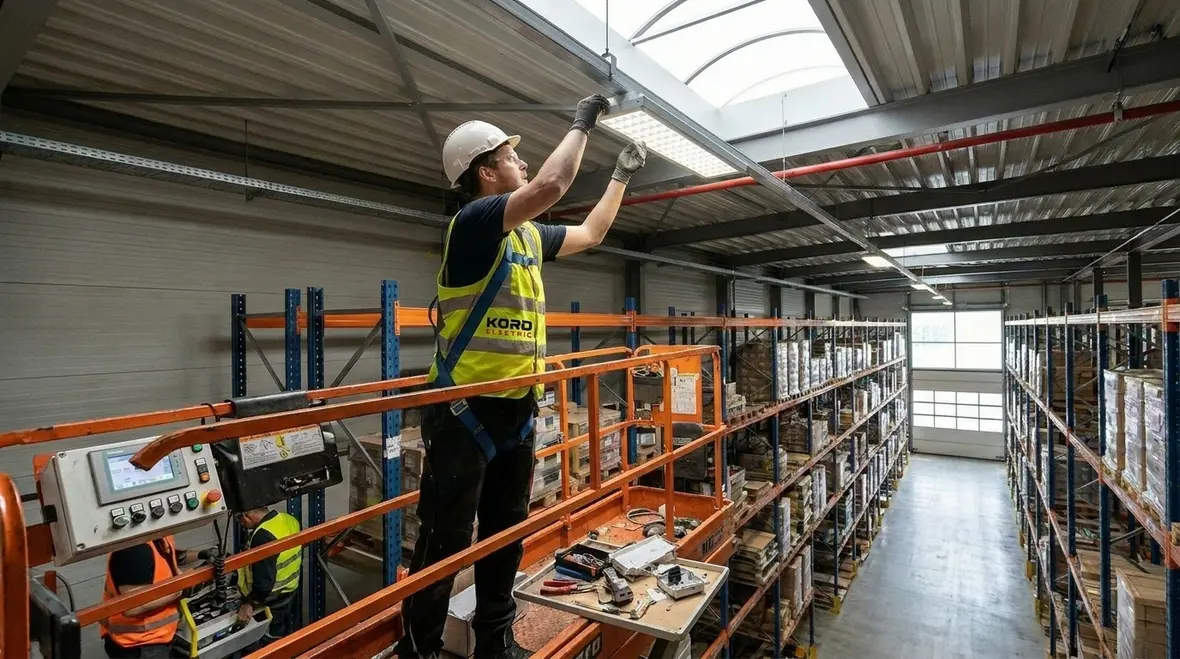
For additional context on how upgrade budgets behave in real facilities, you can also explore our Commercial Lighting Upgrade Cost Guide, which walks through how fixture types, controls, and incentives shape total project investment over time.
Key inputs that decide whether the savings are real
Many retrofit projects stumble because the team overestimates how much lighting will reduce energy use, or they forget that controls matter. For that reason, we focus on the inputs that actually move the needle in commercial and industrial properties.
1) Hours of operation
If a warehouse runs 14 hours a day, the savings scale fast. However, if a building only uses lights for brief shifts, the ROI changes. So we verify schedules with your operations team and review trends from your billing history when possible.
2) Fixture efficiency and total system wattage
New LEDs often beat old lighting by a wide margin, but we still check the details. The “lamp wattage” is not the full story. We account for total luminaire wattage, driver losses, and any special performance needs.
3) Dimming and switching strategy
Instead of treating controls as an optional extra, we evaluate whether your spaces stay occupied consistently or fluctuate throughout the day. Consequently, we match controls to the building’s real patterns.
4) Maintenance costs
This is where many owners get pleasantly surprised. Old systems require relamping, labor time, lifts, and downtime. When we reduce failures and extend service intervals, we improve cash flow. Also, safer maintenance planning becomes easier.
5) Utility rates and incentives
Rates differ by service type and region. In addition, rebates may depend on baseline documentation and fixture performance. Therefore, our service staff helps coordinate the evidence you need so your incentives do not turn into “maybe later.”
And just to be clear, our approach targets only commercial and industrial facilities and major property buildings. We keep the scope focused, because lighting economics in a hospital wing do not behave the same way as in a small retail room with irregular hours.
If you are planning a retrofit that must also satisfy code requirements, pairing this ROI process with our guide on Commercial Lighting Compliance in California can help align savings assumptions with Title 24 expectations from day one.

Energy savings math you can follow without a calculator marathon
To estimate energy savings, we use a clean structure that you and your finance team can review. While every project has unique conditions, the method stays consistent.
Step 1: Calculate current annual energy use
We multiply:
- Existing total fixture watts by
- Annual operating hours by
- Number conversion factor to get annual kWh
Step 2: Calculate post retrofit annual energy use
We repeat the same process using the LED fixture wattage and control adjustment factors, if applicable.
Step 3: Determine annual kWh savings
That is simply the difference between current kWh and new kWh.
Step 4: Convert kWh savings to dollars
We multiply annual kWh savings by your electricity rate. Then, we include demand savings where your utility structure supports it, because some sites benefit beyond energy alone.
Step 5: Add non energy benefits
Next, we include maintenance reduction based on expected relamping frequency, labor, and lift usage. We also factor any operational changes that are tied to lighting performance, such as improved visibility for safety or quality control tasks.
Now, here is the part where we keep things calm: we check the numbers for reasonableness. If the savings look too good, we ask why. Maybe the assumptions drifted. Maybe the operating hours are different than believed. Or maybe the project includes spaces you did not plan to retrofit. We catch those issues early, so your Commercial Lighting Retrofit ROI stays anchored to reality, not wishful thinking.
For California facilities working directly with Title 24, you can also review our California Title 24 Lighting Retrofit ROI Guide, which looks specifically at how energy code requirements and control strategies intersect with ROI for large warehouses and industrial sites.
Controls, maintenance, and lighting quality: the value beyond the bill
Energy is the headline, but it is not the whole story. In a real commercial setting, we often see ROI improve when we align lighting design with how people work and how equipment runs.
Controls that match occupancy
We recommend controls based on space type and use patterns. For example, a loading dock may need different control logic than an office corridor. When we apply the right strategy, lights can stay bright when needed and reduce output when spaces empty. As a result, energy drops without sacrificing visibility.
Reduced maintenance means reduced disruption
Even if two systems save similar energy, the one that reduces lamp or driver failures tends to win. Because the site spends fewer hours dealing with outages and fewer trips for relamping. Maintenance staff keeps time for planned work instead of emergency calls. And we all know emergency calls never arrive with a “please” and a smile.
Better uniformity supports safer work
Lighting affects safety, productivity, and quality. When we upgrade to consistent light levels and appropriate color and glare control, employees can perform tasks with less eye strain. That can reduce errors in precision environments and improve compliance for safety expectations.
Rebate readiness protects your ROI timeline
In many jurisdictions, rebates depend on documentation. Therefore, we support the process with accurate product details and project records. When incentives arrive, ROI accelerates. When they do not, you still have the baseline savings, but the payback can stretch.
Our technicians and service staff explain how these factors change the ROI curve over time, so your leadership team can plan budgeting with confidence.
For facilities planning broader upgrades, pairing lighting improvements with Electrical Preventive Maintenance can help coordinate testing, emergency lighting checks, and documentation so that both energy performance and reliability move in the right direction together.
Common mistakes that shrink ROI, and how we prevent them
We see the same pitfalls across many retrofit attempts, even when the LED product is strong. Fortunately, most issues are preventable with a disciplined approach.
Mistake 1: Using one-zone assumptions for multiple spaces
Different areas have different usage. If you apply one operating schedule to an entire facility, the numbers drift. We separate zones so the savings reflect how each space behaves.
Mistake 2: Ignoring control performance
Controls can cut energy. However, poor placement or mismatched settings can cause lights to stay on longer than expected. We help validate a control strategy that fits your building layout and use.
Mistake 3: Overlooking fixture inventory and exclusions
If you miss even a chunk of fixtures, you lower savings and stretch payback. During planning, our team ensures the scope aligns with the actual installed assets.
Mistake 4: Forgetting maintenance and downtime costs
Relamping labor and lift usage can be meaningful. If you only model energy savings, you understate total value. We include maintenance reductions where they apply.
Mistake 5: Waiting too long to secure documentation for incentives
Incentive programs move with strict timelines. Therefore, we help your team collect what is needed early, so your Commercial Lighting Retrofit ROI does not rely on a “maybe we can file it later.”
ROI scenarios: how decisions change by building type
Commercial and industrial buildings do not share the same risk profile. Consequently, we help teams compare ROI scenarios instead of forcing one estimate as “the answer.”
Scenario A: Facility with long runtime and high visibility needs
High operating hours usually generate fast energy payback. When we add controls and address maintenance, ROI often strengthens. These sites benefit from careful fixture selection and smart zoning.
Scenario B: Multi-tenant or mixed-use major property building
Here, schedules vary by tenant and floor. We recommend a staged approach so each area’s operating hours and requirements get modeled accurately. That also helps reduce disruption.
Scenario C: Industrial plant with harsh environments
Some fixtures see more wear, impacts, dust, or vibrations. In those cases, total system reliability and reduced replacement frequency can drive ROI beyond energy savings.
In all scenarios, our technicians and expert service staff review assumptions and explain tradeoffs in plain language. We help others understand the sensitivity of the result. For example, a small change in runtime or electricity rate can shift payback by months, and you should know that before you commit.
FAQ about Commercial Lighting Retrofit ROI
Ready to model your next retrofit with confidence
If your facility runs lights hard, a lighting upgrade can turn into a real financial win, not just a “nice-to-have.” Kord Electric helps you calculate Commercial Lighting Retrofit ROI with clear assumptions, zone based modeling, and documentation support for incentives. Our technicians and expert service staff explain the numbers as we build the estimate, so your team can decide with calm certainty.
When you are ready to move from modeling to implementation, our Lighting Installation Services team designs, installs, and commissions commercial lighting systems built for code compliance, long-term efficiency, and reliable performance in demanding environments.
Contact us today to review your site details and get a retrofit ROI plan designed for commercial and industrial reality.