
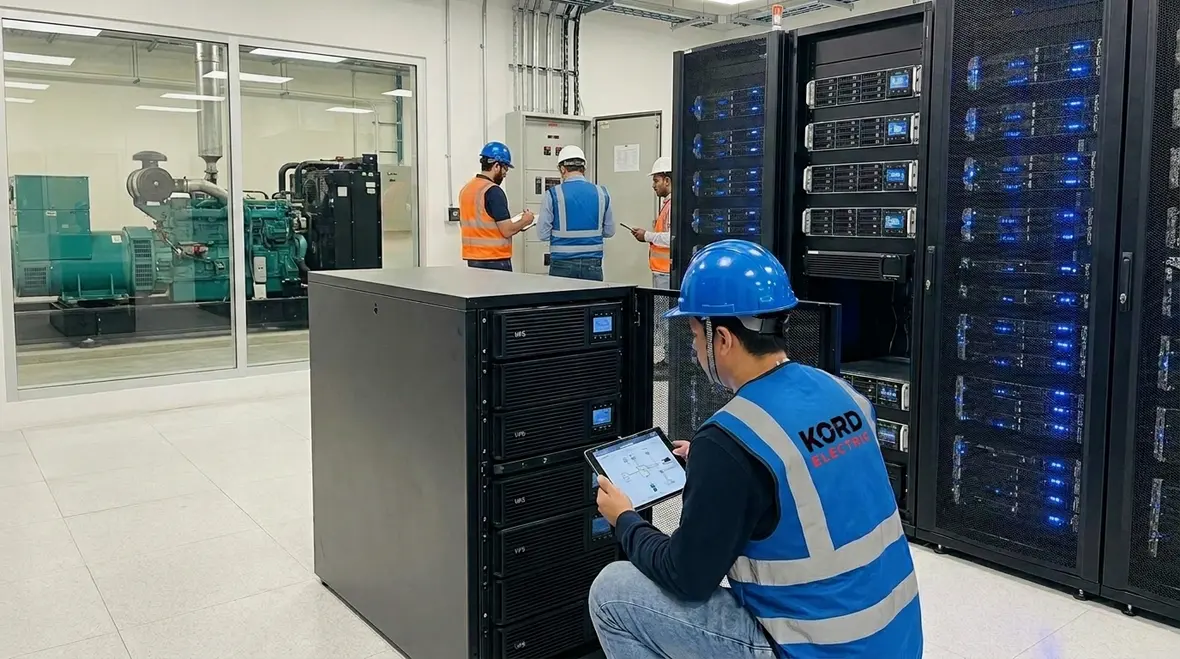
Data Center Power Redundancy for Reliable Uptime
Kord Electric helps commercial and industrial facilities design data center power redundancy that keeps mission critical systems online when something goes wrong. We build plans that think in layers: power coming in from reliable sources, equipment that can switch without panic, and protection that prevents small problems from growing into outages. Then we verify the design with field ready practices, so the uptime story is not just a slide deck. As our technicians like to say, the goal is simple: when the lights flicker in the real world, the data center should not even notice. And yes, we have heard the “it will probably be fine” line. Others say it too, right before the alarms begin.
What uptime depends on in commercial data halls
To keep uptime high, a facility must manage more than one kind of risk. Power loss is obvious, but so are voltage dips, frequency drift, load imbalance, equipment wear, and maintenance downtime. Therefore, the best systems treat the electrical path like a chain with multiple strong links. If one link weakens, the rest carry the load.
When our expert service staff talks with a facility owner, they focus on how your load behaves. They ask what the servers do during peak use, how fast your operations can resume, and which assets must stay live without interruption. After that, we translate your needs into architecture choices that match real operating timeframes. In other words, we plan for how the building actually runs, not how it looks on paper.
Designing redundancy with N plus 1 and beyond

For data center power redundancy, the common starting point is N plus 1, which means you run enough capacity for the full load, plus one extra unit to cover failures. However, we do not stop at the label. We evaluate what “one extra” really means for your distribution layout, your generator size, your switchgear ratings, and your transfer timing.
Next, we look at how the design handles both planned and unplanned events. If a technician needs to maintain a component, the system should keep service while maintenance happens. This is where redundancy becomes practical. A theoretical spare does not help if switching controls delay the transfer or if the bypass path is not ready.
Our team designs with selective coordination and careful load allocation, so one fault does not take out more than it must. And since every commercial and industrial facility has its own constraints, we tune the redundancy level to the risk you can afford.
How we plan for utility, UPS, and generator behavior
A complete plan aligns three worlds: the utility feed, the UPS system, and the standby generator. First, the utility provides stable power most of the time. Then, when utility conditions drift outside acceptable limits, the UPS bridges the gap. Finally, the generator takes over so the UPS can support controlled runtime until longer operation is confirmed.
However, real life adds surprises. A generator may start slower than expected. A UPS may respond differently under low load than under full load. And switchgear interlocks may behave well in factory tests but still need field verification. That is why our technicians do not just specify equipment. They map the operational sequence step by step, including transfer logic and alarm thresholds.
If the facility uses multiple transformers, feeders, or distribution sections, we design the handoff so no single change creates a blackout. We also make sure the design addresses harmonic load, because harmonics can stress transformers and trip protection when you least want it.
Transfer schemes, switchgear, and the art of fast switching
Switching speed matters, but so does switching accuracy. We design transfer schemes that keep critical loads stable during events such as utility loss, maintenance bypass, or equipment replacement. Therefore, we focus on control logic, breaker timing, and interlock strategy so the system performs the same way every time.
We often explain it like this during site walkdowns: power redundancy is not just having spare parts. It is knowing exactly what happens in the next second, and the next minute. When the UPS starts or when a breaker changes position, the control system must act within defined tolerances.
Our expert service staff also checks that the maintenance plan matches the switching plan. For example, if a bypass path exists, technicians must be able to use it safely without bypassing protection. And yes, we keep it business friendly, because facility managers do not want a “clever” scheme that needs a wizard to operate. They want a scheme that works while they focus on tenants, production, or operations.
Designing protection and selectivity to avoid cascading failures
Even with redundant sources, failures can cascade if protection settings and coordination do not match the design intent. So we plan protection like a controlled conversation between devices, where each protection device knows when to act and when to wait.
Our engineers and technicians apply selective coordination across distribution levels. That means a fault on one branch trips only the devices nearest to the fault, while upstream equipment stays available for other loads. When coordination fails, the whole distribution section can drop, even if the fault was small and local.
We also review grounding and bonding practices, because they affect fault current paths and protection reliability. Then we validate load segregation, since isolating sensitive loads from disruptive loads reduces trips and improves stability. If you want uptime, you cannot treat electrical protection as an afterthought. It must be part of the redundancy plan from the start.
Verification, testing, and documentation that technicians can trust
Once Kord Electric designs the power redundancy, we help clients confirm it in ways that matter. That includes testing sequences, reviewing settings, and validating system behavior under realistic transitions. We do this with an eye for what field teams will face during commissioning and maintenance.
In fact, our technicians often stress documentation quality. They want clear one line diagrams, accurate sequence descriptions, and tested operating procedures. If the documentation does not match the real equipment and control logic, then troubleshooting becomes a guessing game. And guessing games are fine at parties, but not during an outage.
Additionally, we align the plan with the electrical requirements for uptime described in our Kord Electric blog article on data center electrical requirements for uptime. That source highlights the need for thoughtful design, proper sizing, and correct protective coordination, all of which we apply during both engineering and field verification.
For facilities that want to zoom out from the redundancy layer and look at the broader backbone, our perspectives in the companion article on data center electrical distribution design for reliability reinforce how architecture, coordination, and maintenance planning all support the uptime picture.
FAQ: Data center power redundancy for uptime
Wrapping it up: build uptime with Kord Electric
High uptime does not happen by luck. It happens when your commercial and industrial facility gets a full power redundancy design that aligns utility, UPS, generator, switching, and protection into one dependable system. Kord Electric designs for real operating behavior, then verifies the sequences your technicians will use during commissioning and maintenance. If you are planning a new major property building or upgrading an existing electrical system, reach out to us. We will help you build a power plan that stays calm when the rest of the building gets loud.
If your facility in southern California needs this level of resilience across multiple properties, you can explore how our broader Los Angeles County electrical services support everything from modern commercial buildings to high demand industrial campuses.
For operators who want their redundancy plan backed by long term care, pairing a robust design with structured service from our commercial and industrial electrical maintenance team keeps breakers, switchgear, and transfer schemes in the condition your uptime targets demand.
When you are ready to move from “it will probably be fine” to a tested, documented power strategy, Kord Electric can help you build data center power redundancy that stays composed when everything else gets noisy.


