
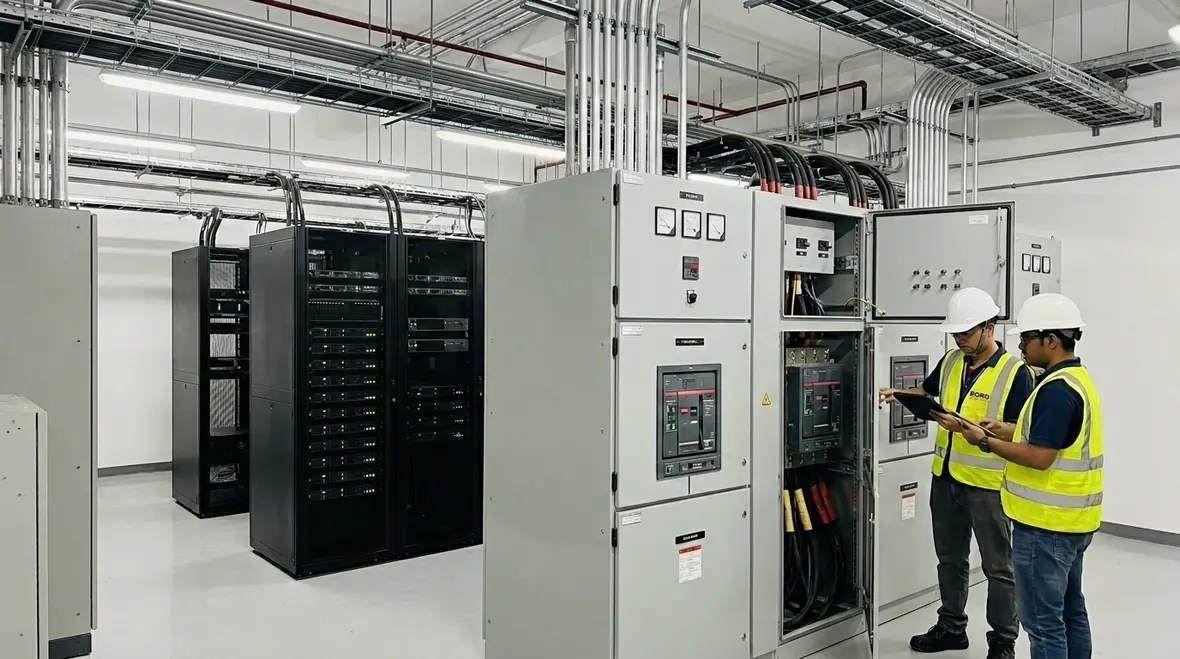
Data Center Power Redundancy From Day One
How Kord Electric approaches data center power redundancy from day one
Data centers run on timing, and timing demands data center power redundancy. At Kord Electric, we help commercial and industrial facilities build electrical systems that keep critical loads alive even when something fails. In fact, our approach starts with design choices that reduce single points of failure, then continues with field testing and documentation that operators can trust. And yes, we explain it clearly, because complex power planning should not feel like a mystery novel written by a malfunctioning transformer.
To make this practical, we follow a reliability mindset across distribution architecture, protective coordination, transfer logic, and maintenance paths. Our technicians and expert service staff then walk clients through what happens in real failure scenarios, step by step, so teams know what to expect when the lights do not go out. Now let us lay out the essential strategies.
Design for fault tolerance in electrical distribution systems
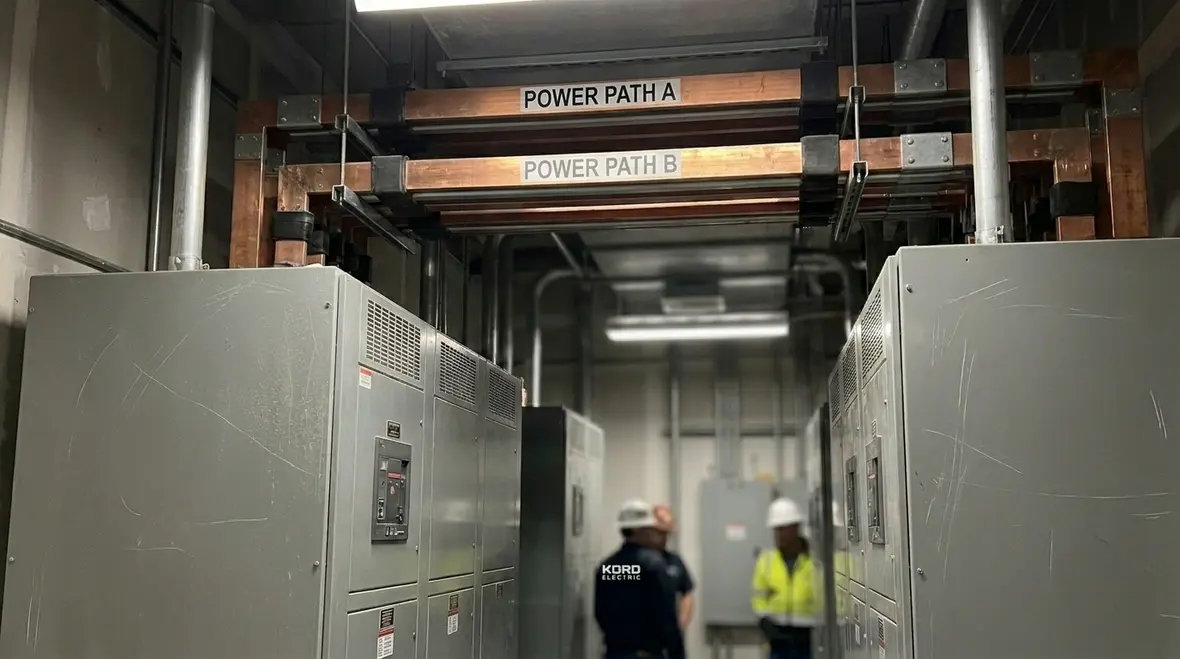
When others design for “normal operation,” they often leave gaps for abnormal events. We design for fault tolerance instead. That means engineers plan how power flows during steady state, and also how it reroutes when a breaker opens, a feeder trips, or a component overheats. Data center power redundancy is not just more equipment. It is the ability of the system to keep supplying power without creating new risks while switching between sources.
First, we support architectures that separate critical paths. Then we use disciplined feeder routing and clear load grouping. As a result, a problem in one area does not automatically spill into the rest. Furthermore, we align distribution levels so that the shortest route stays reliable, while backup routes stay ready. In other words, we do not rely on luck. We rely on layout.
Our service staff also helps clients understand why reliability depends on more than one diagram. They help validate assumptions during commissioning, review protective device settings, and confirm that the control logic actually matches the design intent. After all, “it should work” does not help when the building is on the clock.
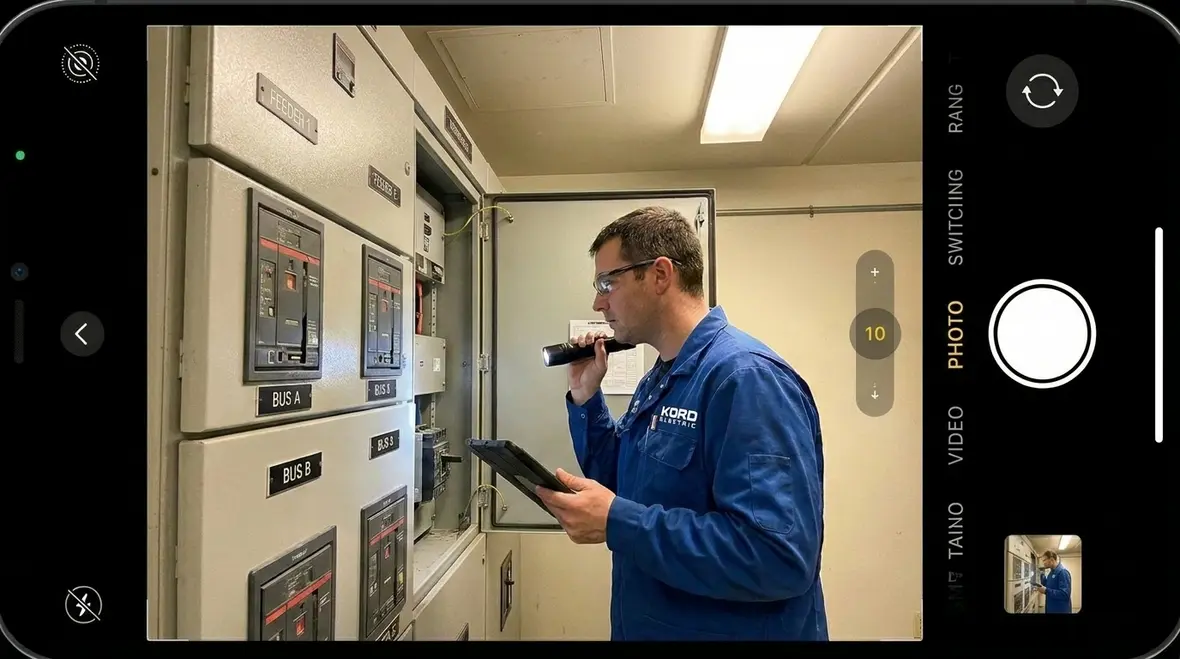
Dual power paths: keep both sources usable and independent
A strong strategy uses dual power paths, but it must also ensure those paths are independent in the ways that matter. We plan for electrical separation so that a fault on one path does not compromise the other. That separation includes switching elements, bus sections, feeder conductors, and control wiring routes where appropriate.
Then we design redundancy with usability in mind. If the backup path requires a shutdown to become operational, it stops being redundancy and starts being a “future project.” Instead, we aim for a system that can transfer quickly, with stable voltage and correct load behavior. Transition time matters, especially when modern equipment includes power supplies that tolerate a narrow window.
Here is the punchline that keeps showing up on job sites: even the best redundancy fails if maintenance makes it unreachable. So our technicians build access plans into the design conversation. They help operators schedule inspections, test transfer components, and keep protective devices within expected performance limits.
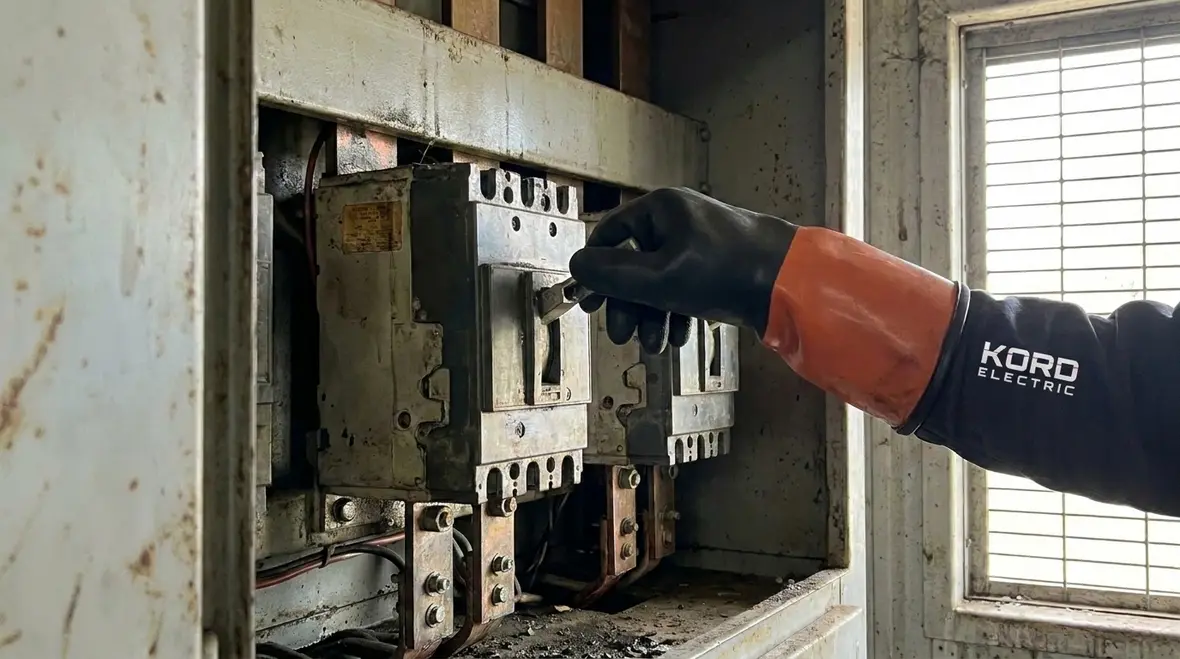
Transfer and switching logic that operators can trust
Switching is where reliability gets real. Many teams focus on the generator or utility feeds, then treat transfer switching as an afterthought. We treat transfer logic as a core part of the architecture. That includes making sure interlocks prevent unsafe states, verifying that automatic transfer equipment behaves as designed, and confirming that signals and controls fail in a safe way.
In addition, we align switching strategy with the load profile of the facility. Data center loads often include heat sensitive equipment, plus storage and networking that need consistent power quality. Therefore, we coordinate transfer behavior with power quality requirements, including voltage stability and transient behavior.
Our expert service staff often explains this in a simple way during site walkthroughs. They talk through what the system does when a source drops, then show how the other path picks up responsibility. And when clients ask, “What if a breaker refuses to close?” we answer directly. We explain how the protection and monitoring systems guide the next safe action.
Protection and coordination: stop faults, prevent cascading trips
Redundancy does not mean “ignore faults.” In fact, the best systems remove faults fast and isolate them cleanly. That is why protective coordination matters. We design protection so the correct device clears the fault first, without waiting for a larger upstream breaker to trip everything.
When protection is coordinated well, a local fault stays local. Then the rest of the distribution continues to feed critical loads through the alternate path. However, when coordination is weak, the system can behave like a row of dominoes. One issue triggers a chain reaction, and suddenly the “backup” path is the only thing left working, until it trips too.
Our technicians also support the field side of protection. They review settings, confirm device ratings, and validate that time-current curves align with the planned behavior. After that, we help teams build maintenance and testing steps that do not disturb the coordination. Because the day after maintenance is the day you learn whether the system was actually dependable.
Power quality and monitoring for steady, clean output
Even when power stays on, the quality can still fail. That is why we treat monitoring and power quality as part of redundancy, not an optional extra. We help clients plan metering points, alarm logic, and trending so the team sees a problem early, before it becomes a trip, an overheating event, or a silent performance issue.
Critical loads often need stable voltage and predictable frequency, plus clean waveforms that do not stress equipment. Therefore, we consider harmonics, grounding behavior, and voltage regulation through the distribution path. We also support the use of monitoring tools that help operators identify which section is drifting out of spec.
Transitioning from “we think it is fine” to “we can prove it” changes how organizations manage risk. And yes, monitoring can feel like extra work, until it saves a production window or helps a facility team avoid a repeating nuisance trip.
Maintenance access and test strategy so redundancy survives real life
Many designs look perfect during plan review, then fail during maintenance because the system becomes awkward or unsafe to service. We plan maintenance access and testing so that redundancy stays real, not theoretical. That means clear procedures for lockout and switching, safe ways to isolate sections, and planned methods for exercising transfer components.
In practical terms, our technicians help develop testing windows that match facility operations. Then they document what should happen, what readings to expect, and what triggers require follow-up. As a result, teams can perform routine tasks without introducing new faults.
We also guide clients on training. Our expert service staff explains the logic behind transfers, interlocks, and protective isolation so operators and maintenance teams share the same understanding. When everyone speaks the same electrical language, the facility runs smoother. And fewer people get called at 2 a.m., which is good for morale and good for budgets.
Reliable distribution design for commercial and industrial facilities
Our work targets commercial and industrial facilities and major property buildings. Therefore, the design priorities often balance uptime, budget discipline, and realistic operations. In large facilities, distribution design becomes a living system: it changes with tenant needs, expansions, and equipment upgrades.
To support that reality, we recommend a structured process. First, we map critical loads and define what “stays up” means. Next, we design data center power redundancy into the distribution tiers that matter, then we review protective behavior and switching steps. Finally, we document everything so expansions do not accidentally break reliability assumptions.
This kind of approach aligns closely with the reliability design principles outlined in Kord Electric’s article on data center electrical distribution design for reliability. We use those concepts, then we translate them into field-ready steps for engineering teams and maintenance staff.
FAQ
Call Kord Electric for a reliability-focused power plan
If your facility depends on uptime, you deserve a power architecture built for real failures, not just ideal conditions. Kord Electric helps commercial and industrial teams design and service reliable electrical distribution, with coordinated protection, dependable transfer logic, and maintenance-ready redundancy. Our technicians and expert service staff explain each decision in plain language so your team can operate with confidence. Reach out today to review your current setup, identify risk points, and build a clearer path to dependable power.
For data centers and major property buildings that want to take the next step beyond design, pair your data center power redundancy strategy with a structured maintenance program. Kord Electric’s commercial and industrial electrical maintenance plans help keep breakers, switchgear, and redundant power paths operating the way they were designed, year after year.
Whether you are planning a new build, upgrading legacy infrastructure, or rethinking how your current electrical system supports uptime, Kord Electric can help you connect the dots between design, protection, and day-to-day operations. Our team builds electrical systems that match how your facility truly runs, then supports them with clear documentation and service.
If you are ready to align your redundancy strategy with long-term reliability, start by exploring our focused guidance on data center electrical infrastructure essentials. Then, when you are ready for a project-specific conversation, our service team is here to help you turn those concepts into a practical, field-tested plan.


