
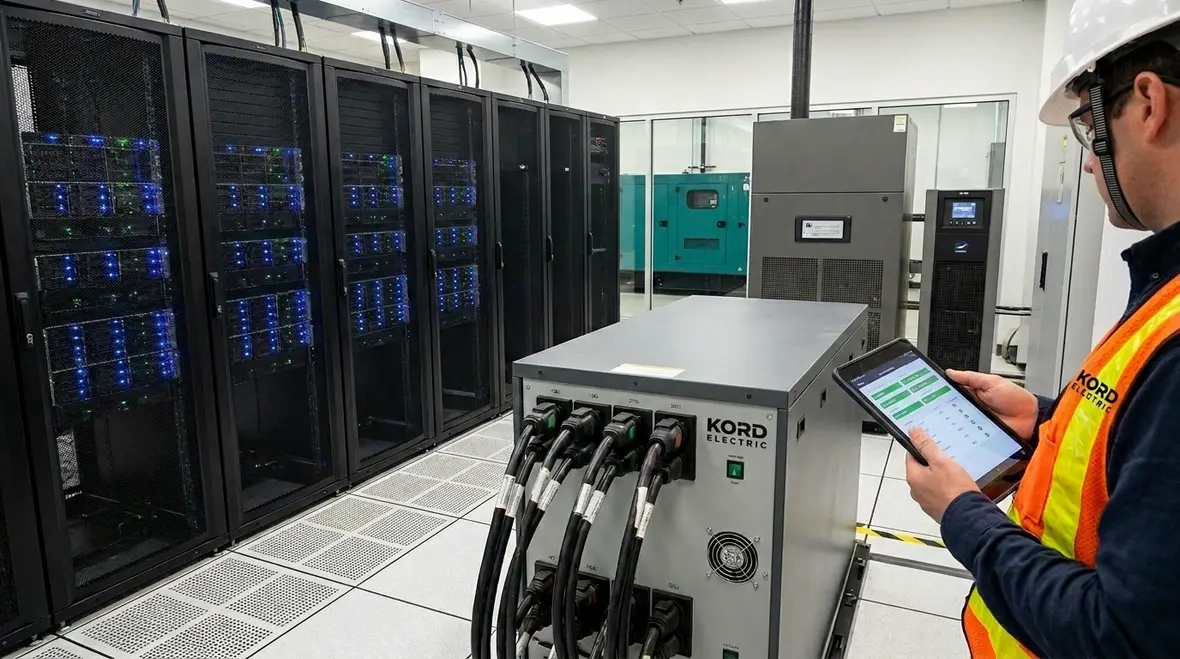
Data Center Uptime with Power Redundancy
Introduction: Advanced Redundancy That Keeps the Lights On
At Kord Electric, we start with one goal, maximizing data center uptime through advanced redundancy strategies for power distribution. In plain terms, we build power systems that can take a hit and keep running, because in a data center, downtime does not just cost money, it costs trust. So we design for continued operation when one path fails, when maintenance happens, and when the unexpected arrives wearing a “this will be quick” disguise.
In this guide, our service team and technicians explain how others can plan redundancy like professionals, not like people flipping a light switch and hoping for the best. And yes, we still make room for calm humor, because even serious electrical work deserves a steady hand.
Understanding Uptime Targets and Power Distribution Paths
First, we align on what “uptime” means for the facility. Then we map how power flows from utility service to critical loads. Because even the best hardware cannot protect you if the design ignores the real failure modes. Our technicians typically walk clients through the electrical requirements discussed in our data center electrical requirements for uptime blog, including how load categories drive design choices and how power quality affects long term operation.
Next, we divide the system into practical paths: normal operation, maintenance states, and failover states. At this point, we also define transfer times and the acceptable interruption window for IT gear. That matters, since some systems tolerate brief transfers, while others demand near seamless continuity.
Finally, we treat power distribution as a living system. In other words, we plan for growth, not just today’s load. When others design for tomorrow with flexibility, they reduce future outages caused by rushed upgrades or mismatched switchgear configurations.

Designing Redundancy at the Utility Interface Level
Utility power forms the first link, and we do not ignore it. So we often recommend multiple utility feeds where the site allows it. This approach reduces dependency on a single source. However, simply adding feeds is not enough. We coordinate how those feeds enter the building and how they route power into the distribution gear.
Then we address common failure points. For example, a shared duct bank, a single transformer bank, or one set of meter points can turn “two feeds” into “one problem with better branding.” Our expert service staff explains this clearly on site, because clients deserve truth, not vague reassurance.
Also, we evaluate protective coordination so one fault does not cascade into a sitewide outage. That means selecting protective devices that isolate the fault quickly, while keeping healthy paths online. Over time, this helps stabilize operation during storms, utility events, and internal electrical faults.

Applying N+1 and 2N Systems for Critical Loads
After the utility interface, we focus on the heart of redundancy: how generators, UPS systems, and switchgear share responsibility. Most facilities aim for N+1 or 2N depending on risk tolerance, budget, and service level requirements.
In an N+1 design, we provide one extra unit beyond the required capacity. So if a generator or UPS module fails, the system still carries the load. Meanwhile, in a 2N design, we build two independent power trains so critical loads can run on either train without reliance on a shared component. That reduces the impact of maintenance and certain single points of failure.
Our technicians also help others avoid the common trap of assuming “extra equipment” automatically equals “extra reliability.” Instead, we design the whole chain: paralleling logic, module control, battery management, and transfer schemes. This is where many teams either shine or slip. We help them shine.
And as a pop culture reference, think of it like a well run superhero team. You do not just bring more costumes. You coordinate roles, communication, and backup plans. That is how power distribution stays ready.

UPS, Batteries, and Transfer Schemes That Reduce Unplanned Events
To keep IT loads stable, we plan UPS architecture with care. A UPS does more than “hold power.” It conditions voltage, supports ride through during transfer, and bridges the gap between utility loss and generator start. Therefore, we look at runtime, battery string design, recharge strategy, and monitoring practices.
Next, we refine transfer schemes. We ensure the switching devices move power cleanly and predictably. We also design for maintenance so technicians can service equipment without turning the site into a “lights out” learning experience.
Then we set up operational controls that reduce the chance of human error. For instance, we design interlocks and status monitoring so the wrong configuration becomes hard to create. Our expert service staff explains these controls in plain language, because most failures do not start in the product. They start in the process.
In the real world, batteries age. So we plan for replacement cycles and include monitoring alarms that call attention early. When others detect battery degradation sooner, they prevent failures during high demand. And nobody wants their UPS to behave like a phone battery that only lasts long enough to take one dramatic selfie.

Generator Redundancy, Fuel Strategy, and Load Management
Generators provide long duration support. However, redundancy only holds up when fuel supply, start logic, and load sharing stay reliable. We help clients plan fuel strategy based on code needs, local conditions, and test schedules.
Then we manage startup and load sequencing. When multiple generators run in parallel, the control system must share load properly. That prevents overloading a single unit while others sit underutilized. Additionally, we plan for temperature, maintenance access, and the reality that engines need attention even when nobody is looking.
We also focus on load management practices. Not every load must start instantly. Critical loads must, but non critical loads can follow a sequence that protects generator capability. This approach keeps performance stable and avoids nuisance overload trips.
Finally, we coordinate generator redundancy with UPS and switchgear behavior. When the transitions line up correctly, the critical loads experience smoother power delivery. In other words, we remove the “cliff edge” that happens when systems transfer out of sync.
Switchgear, Branch Distribution, and Preventing Cascading Failures
Switchgear and branch distribution shape how faults travel. If a fault in one circuit triggers a bigger shutdown than needed, the entire site feels the pain. So we design with selectivity in mind, meaning protective devices isolate faults while preserving healthy paths.
We also account for maintenance mode operations. For example, when others open doors for inspection or component replacement, the design should keep at least one path available for critical loads. Our technicians verify the operational modes during commissioning so the “as built” reality matches the “as designed” expectation.
To prevent cascading events, we use proper bus configuration and thoughtful distribution layout. We also plan grounding and surge protection based on equipment needs and power quality targets. This supports stable operation for sensitive IT gear and reduces risk from spikes caused by switching events.
And yes, we test. Because in commercial and industrial facilities, trust comes from evidence. Our team runs scenarios and checks alarms, so the system does not just look right on paper.
Testing, Commissioning, and Ongoing Maintenance Programs
Even a strong design can fail if the program around it is weak. That is why we build commissioning and testing into the lifecycle. We validate transfer times, protective device behavior, UPS runtime, generator start reliability, and switchgear interlocks. Then we document results so the facility can track performance over time.
After that, we set up ongoing maintenance programs that match the system’s criticality. Battery inspection, generator exercise, switchgear testing, and sensor calibration all play a role. As equipment ages, parameters drift. Therefore, we treat maintenance as risk control, not as a checkbox.
Our expert service staff also trains on operational practices. Because when operators know what alarms mean and how to respond, the chances of small problems turning into long outages drop dramatically. That is operational redundancy, and it works alongside hardware redundancy.
If you want a simple truth, it is this: the most advanced redundancy strategies still need human coordination. We bring both.
Connecting Redundancy Design with Long Term Service
When we help organizations implement data center power redundancy strategies, we also consider how service teams will support the system five or ten years from now. That includes documenting settings, labeling equipment clearly, and aligning the design with structured commercial and industrial electrical maintenance plans. A redundant system only delivers uptime if inspections, testing, and repairs keep pace with real world conditions.
For multi-site portfolios or large campuses, coordination also extends across facilities. Standardized maintenance practices, shared spare parts strategies, and consistent reporting all make it easier to sustain uptime targets without reinventing the playbook for every building.
Planning for Future Loads and Technology Shifts
Data center loads rarely stay static. New racks, higher density deployments, and changing cooling strategies all place fresh demands on the electrical system. When we plan redundancy, we reserve capacity and flexibility so those changes do not force risky shortcuts later. That might mean additional space for switchgear sections, modular UPS capacity, or conduit routes ready for future feeders.
This mindset lines up with broader infrastructure work across commercial and industrial properties, where rewiring projects and distribution upgrades must anticipate tomorrow’s equipment, not just today’s load. Redundancy design that ignores growth ends up feeling like a tight jacket: technically functional, but uncomfortable the moment you try to move.
When we tie these planning steps into our broader commercial services in regions like Los Angeles County electrical services, organizations gain a consistent partner that understands both mission critical uptime and everyday facility demands.
FAQ
Conclusion: Build Redundancy You Can Trust
When others chase uptime, they often buy equipment. At Kord Electric, we build the full system, so your power distribution stays ready through faults, maintenance, and real outages. Our technicians and expert service staff help commercial and industrial facilities plan redundancy, validate performance, and maintain reliability over time. If you want data center uptime protection that does not rely on luck, reach out to Kord Electric today. We will review your current setup and map the safest path forward.
If your facility is planning a new build, expansion, or reliability upgrade, our team can connect this redundancy strategy with broader services across Southern California, from critical power support to infrastructure improvements. For many organizations, combining robust redundancy design with services like distribution optimization and code compliant upgrades creates a foundation that supports growth instead of fighting it.
When you are ready to align your redundancy roadmap with practical, boots on the ground electrical expertise, the next step is a focused review of your current system and uptime goals. From there, we build a clear path toward resilient, testable, and maintainable power distribution you can trust.


