Commercial EV Charging Infrastructure Design for Real Sites
At Kord Electric, we start with a commercial ev charging infrastructure design that fits how your property actually works, not how a brochure imagines it should. In the first planning sessions, our team maps power, parking flow, and future growth so the charging network stays useful long after day one. And yes, we handle the boring stuff too, like electrical load studies, permitting, and hardware placement. Because nothing kills momentum like a “small” wiring change that turns into a week of schedule chaos. Others often learn that lesson the hard way. We would prefer you learn it once, then move forward.
Now, we explain the essential planning steps for commercial EV charging infrastructure installation, in plain terms, with our expert service staff guiding the process from design to final commissioning.
Commercial EV Charging Infrastructure Design, Built for Real Sites
When we talk about commercial EV charging infrastructure design, we are not sketching fantasy parking lots on a whiteboard. We walk the actual pavement, look at the panels that already feed your building, and ask how your operations really work. Do employees arrive in waves or trickle in? Do trucks stage near loading docks for hours or turn around quickly? How tight is the parking, and where do visitors usually wander when they step out of a vehicle?
Those details shape where power can safely land and how drivers actually use the chargers. A design that ignores them might look fine on paper but turn into daily frustration in the field. By contrast, a grounded design blends with your existing traffic, your shift patterns, and your building’s electrical backbone. That is the only kind of commercial ev charging infrastructure design worth installing, because it respects the schedule, not just the spec sheet.
This is also where long term thinking starts. Commercial sites evolve. Tenants change, fleets grow, and new equipment lands in what used to be “empty” panel space. A good design anticipates that, leaving room for later chargers, additional feeders, or upstream upgrades without tearing out everything you just built. We plan with your next five to ten years in mind, not just the ribbon cutting photo.
If you want a deeper dive into how these decisions affect cost, timing, and scope, Kord Electric also shares planning insights in resources like our commercial EV charging installation cost guide and our overview of EV charging infrastructure scalability for commercial sites. Those articles walk through how power, layout, and growth plans all connect to your budget and schedule in practical terms.
Site Audit and Load Planning That Prevents Headaches
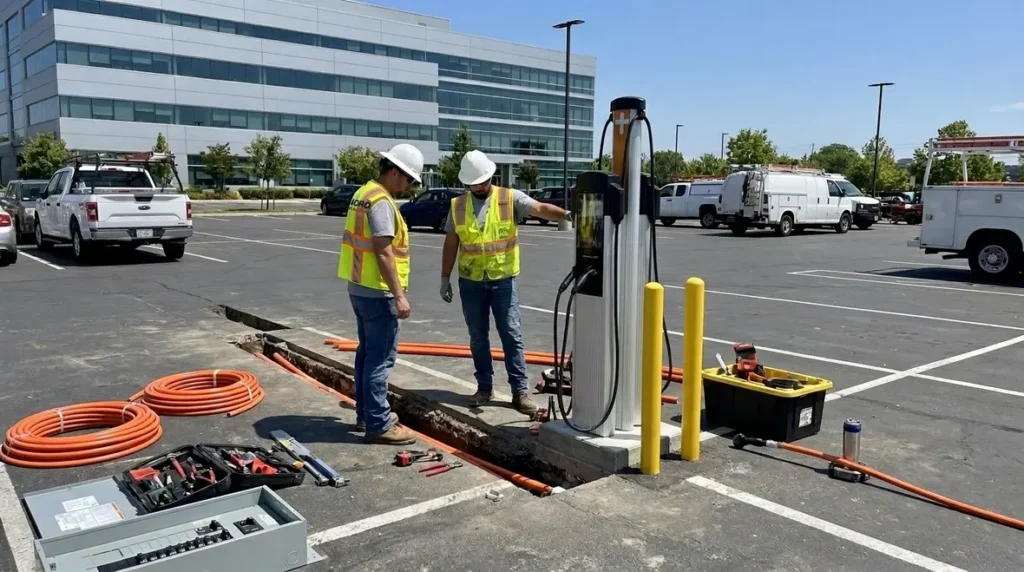
To install commercial EV charging infrastructure the right way, the process begins with a site audit. First, our technicians walk the facility, review the parking layout, and confirm how vehicles arrive, park, and depart. Then we evaluate electrical capacity using utility data, one line diagrams, and existing panel conditions. After that, we identify the best path for conduit routing and transformer upgrades, if they are needed.
Most property managers want charging that works on day one. However, that depends on load planning. So we calculate expected demand based on charger power levels, anticipated usage windows, and site occupancy. In addition, we consider demand response options when appropriate, which helps manage peak draw.
Here is where our expert service staff earns its reputation. We do not just “add chargers.” Instead, we plan the electrical foundation so the facility can support charging while still running normal operations. If a facility runs HVAC, refrigeration, manufacturing equipment, or large lighting loads, we treat those as first class citizens. Because the grid does not care about our deadlines, and neither should the design.
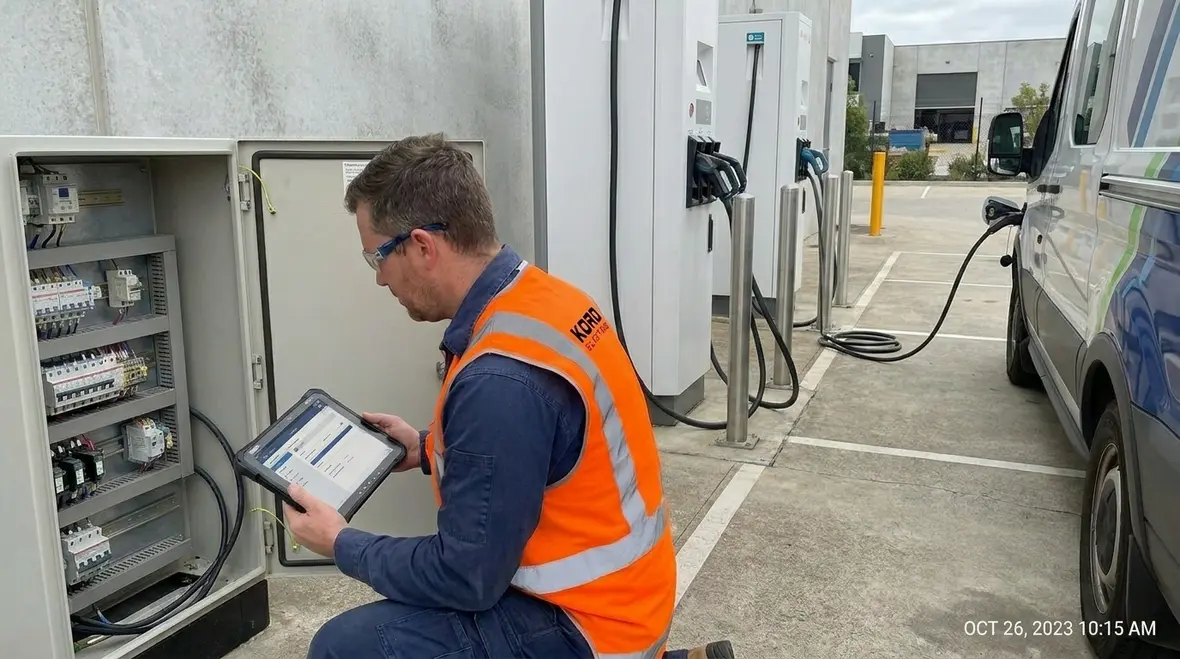
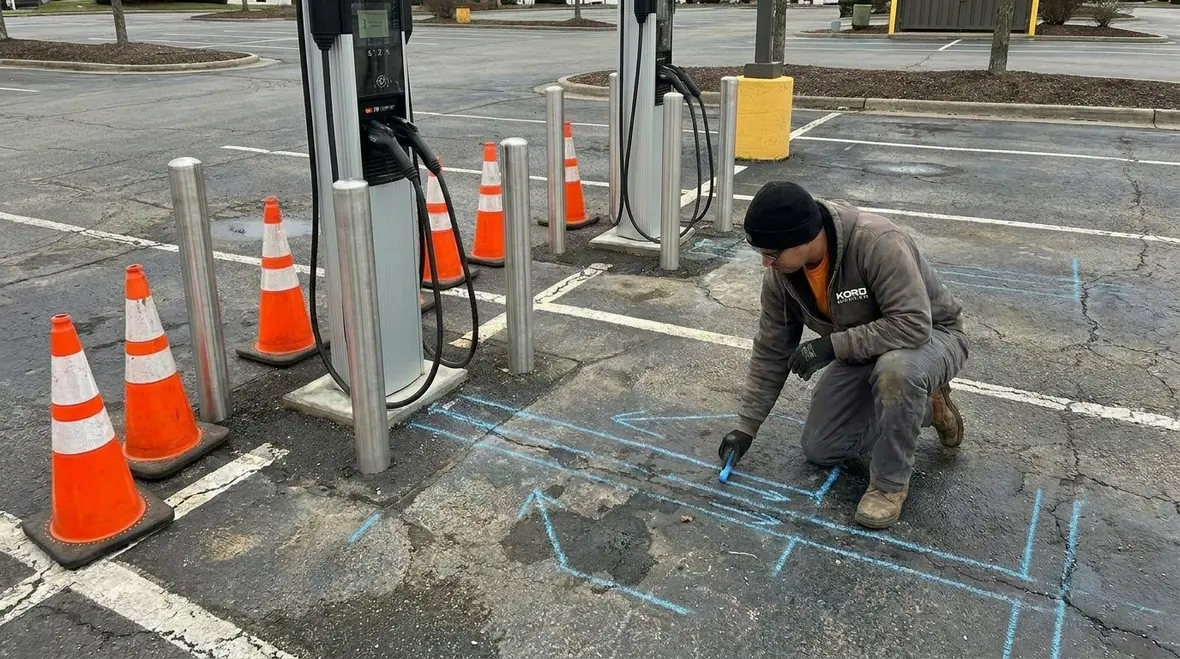
During this audit, we also look for hidden constraints that could complicate things later: buried utilities where you expected clean trenching, aging switchgear that does not love new loads, or panelboards that were “temporarily” overloaded five years ago and never fixed. Getting honest about those conditions early allows us to build a plan that prevents surprise shutdowns halfway through conduit runs.
When the load planning phase is handled correctly, you end up with realistic answers to the big questions: how many chargers you can support today, what upgrades unlock the next tier of capacity, and how to phase the work so your operations do not feel like a never ending construction zone. That foundation carries through everything else, from permit drawings to the way breakers are labeled in your panels.
Permits, Utility Coordination, and Compliance That Moves Fast
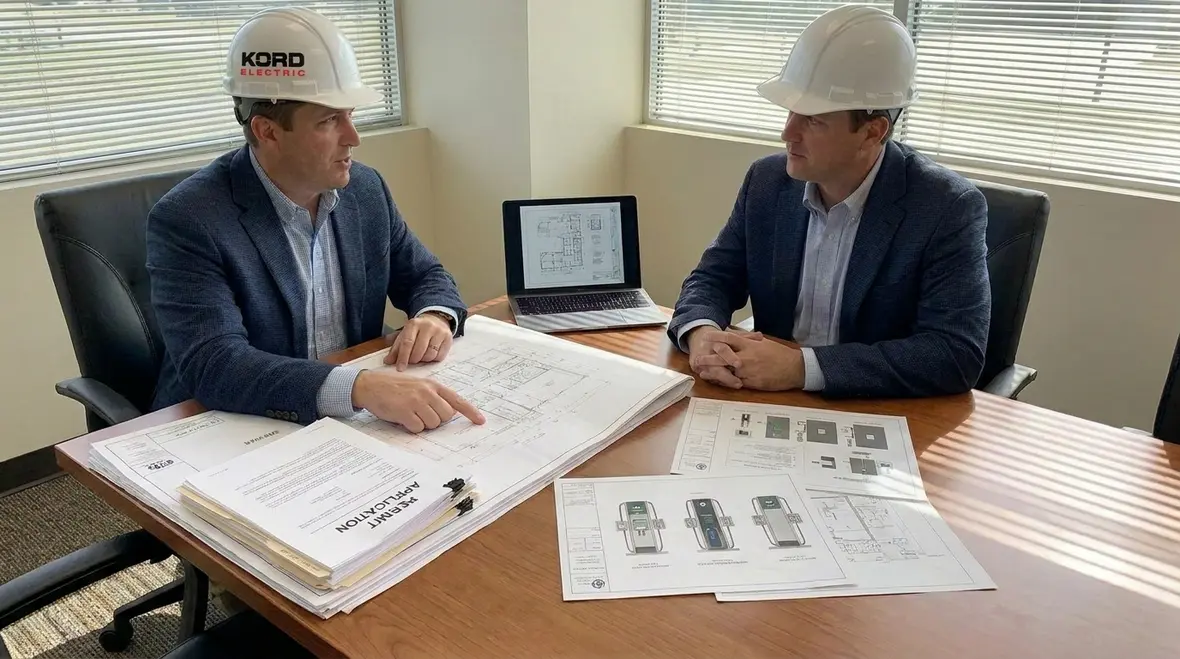
Next comes permits and utility coordination, the part people often avoid until it becomes urgent. Yet for commercial and industrial facilities, paperwork and process matter as much as hardware. Our approach starts with a review of local requirements and utility rules, so the project avoids surprise redesigns.
We coordinate with the utility early, including service availability checks and transformer or meter considerations. Then we prepare documentation that aligns with code and inspection expectations. Meanwhile, our team tracks timelines and dependencies, such as transformer lead times, survey needs, and electrical inspection scheduling.
Also, we help clients understand compliance steps in a realistic way. Some sites need traffic control planning for installation zones. Others need signage and accessibility considerations. We address these early, so the contractor crew does not improvise later. And improvisation is fun only in movies. In real life, it usually costs money.
The same disciplined attitude shows up when incentives or specialized programs are involved. Whether you are navigating EV charger rebates for California commercial properties or local air district grants, the order of operations matters. Starting construction too early or missing a critical document can cost real money. By threading code compliance, utility coordination, and incentive rules together from the start, we keep your project on the fastest realistic path instead of bouncing between corrections.
Smart Layout and Power Routing for Efficient Parking Flow
After we confirm capacity and compliance paths, we shift to layout design. Parking flow is not cosmetic. It affects safety, usability, and uptime. Our technicians design the charging bays to support vehicle access without blocking fire lanes or creating hazardous pedestrian crossings. Additionally, we consider queueing, turn radius, and how drivers enter and exit the area during peak hours.
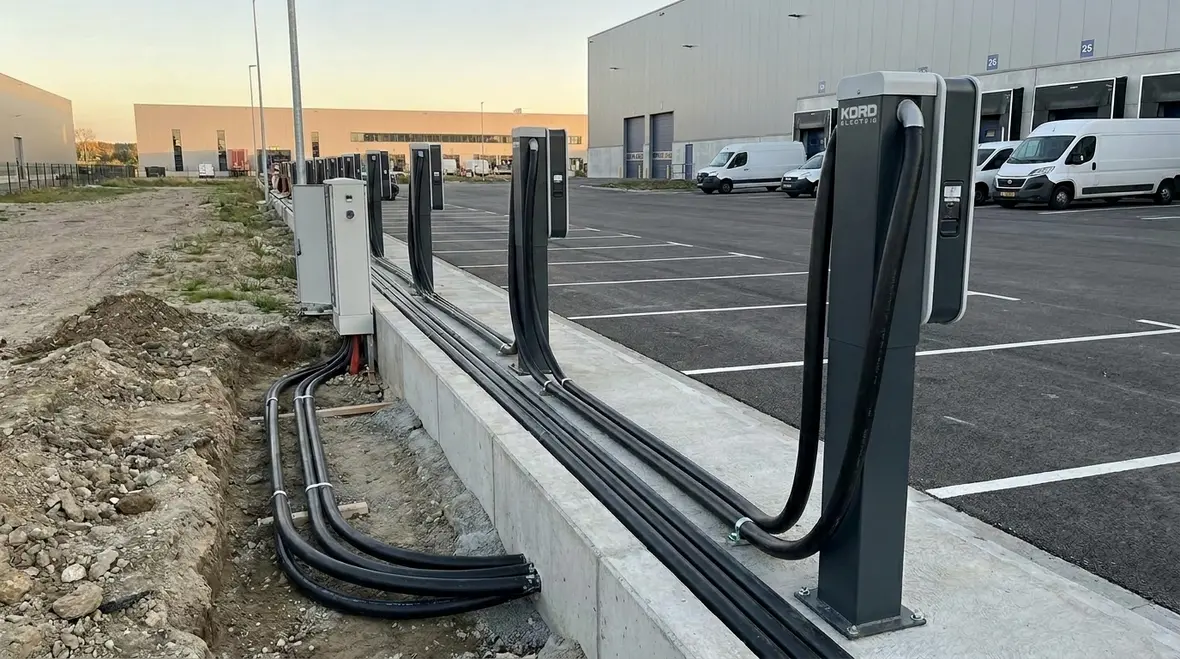
Then we plan power routing. Because the shortest conduit run is not always the best conduit run, we select routes that minimize long future disruptions. We also consider future expansions, such as additional stalls or higher power charging, so the infrastructure does not need to be dug up again.
In this stage, our team also thinks about cable management, mounting locations, and weather exposure. We design for the real world: rain, snow, wash down areas, and accidental impacts. If the facility operates with heavy equipment or forklifts nearby, we plan protection strategies too.
Simply put, we create a layout that makes sense today and still makes sense tomorrow. Many of those same principles show up in our broader infrastructure work, like addressing voltage fluctuations in commercial and industrial facilities, where clean power paths and stable distribution protect sensitive equipment as much as they protect chargers.
This is also where we think about the human side of the design. Where do drivers wait while vehicles charge? How do you keep cables from becoming trip hazards? Can service technicians reach equipment without blocking the entire row of spaces? We answer those questions in the drawings, not after the bollards are already set in concrete.
Hardware Selection and Reliability for Industrial Use
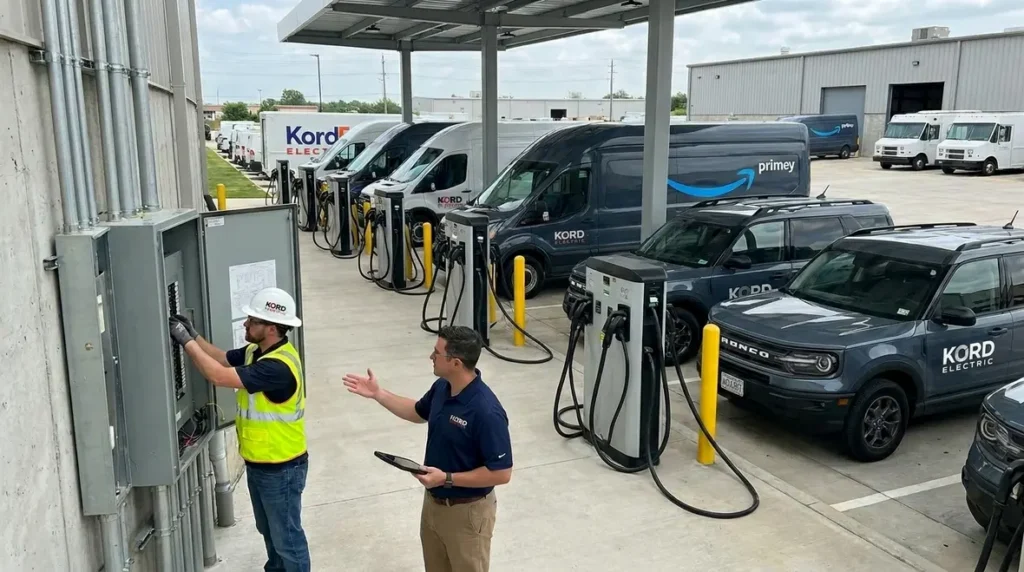
When selecting chargers, we focus on reliability and maintainability, especially for warehouses, campuses, and major property buildings. First, we match equipment specs to site needs, including power output, connector type, and available space for control hardware. Then we evaluate network options, like whether the site needs reporting, user access controls, and usage tracking.
Because commercial sites do not run like single home garages, we look beyond “it powers on.” We confirm that the equipment supports the operating model, whether your fleet uses it daily, your tenants access it, or your visitors need managed access. We also consider load balancing and fault handling, since a stable charging experience builds trust and reduces calls for service.
Our expert service staff also reviews long term maintenance steps. We plan clear access for inspections and component service, and we help clients understand what preventative maintenance looks like. That way, uptime does not rely on luck. It relies on a plan, and we build that plan up front.
In many facilities, that plan connects directly to broader reliability programs like commercial and industrial electrical maintenance plans. When EV charging ties into your overall maintenance strategy, inspections, testing, and recordkeeping for chargers become part of a predictable rhythm instead of a scramble every time a status light turns the wrong color.
Installation Execution, Safety, and Commissioning That Works
Once design and equipment selection are locked in, we move into installation execution. Our team sequences work to reduce disruption to operations. We schedule around facility needs, coordinate access to electrical rooms and parking areas, and keep safety controls in place.
During installation, we handle trenching, conduit, wiring, and panel work with a focus on code compliant practices. Then we install chargers, breakers, and controls, while verifying mechanical stability and grounding. After that, we test systems step by step to confirm power delivery, communication, and protection functions.
Finally, we commission the system. This is where others may stop at “it charges a car.” We do more. We verify performance under realistic conditions, confirm network connectivity, and test user flows that match the site model. Then we document the results for ongoing operations and service planning.
In short, we treat commissioning like a launch checklist, not a casual handshake. Our team runs through electrical, mechanical, and software checks so each charger behaves predictably when the first wave of drivers plugs in. That same mindset drives our dedicated EV charger installation services, where commercial and industrial sites get a full, field proven process from assessment through final testing.
Operations Support, Monitoring, and Expansion Readiness
After installation, the real work begins: operating and maintaining a charging network. Kord Electric supports commercial clients with guidance on usage patterns, reporting, and issue response. We also help sites plan expansions without causing major downtime.
Because charging demand grows, we design for capacity and smart scaling. If the facility later adds more bays, we evaluate what upgrades will be needed and how to implement them with minimal disruption. Also, we advise on monitoring approaches so the site can spot performance issues early.
We know facility teams do not want surprise maintenance windows. Therefore, our expert service staff shares service expectations and recommended schedules, based on the environment and equipment type. And if you think this is overkill, remember that a small outage can be like a dropped espresso on a white shirt. It ruins the day, and it does not get cleaner on its own.
Underneath all of this sits a simple idea: commercial ev charging infrastructure design should make future scaling easier, not harder. When your first phase is built with clear pathways, accurate load data, and documented commissioning results, phase two (and three, and four) stops feeling like a reinvention and starts feeling like a straightforward expansion.
FAQ: Commercial EV Charging Infrastructure Planning
Conclusion: Let Kord Electric Plan Your Next Step
If your facility runs on tight schedules and real operational needs, you deserve planning that respects the details. Kord Electric delivers commercial EV charging infrastructure design, load planning, permitting coordination, and safe installation for commercial and industrial sites. We bring expert service staff to guide the process, so you avoid delays, rework, and surprise electrical issues. Ready to move from ideas to a working charging network? Contact us today to start a site assessment and get a clear project path.
If you are ready to connect design with field proven execution, explore our dedicated EV charger installation services. From the first planning walk to final commissioning, we align your commercial ev charging infrastructure design with real world power, parking, and performance so your site stays reliable on day one and scalable for the future.