
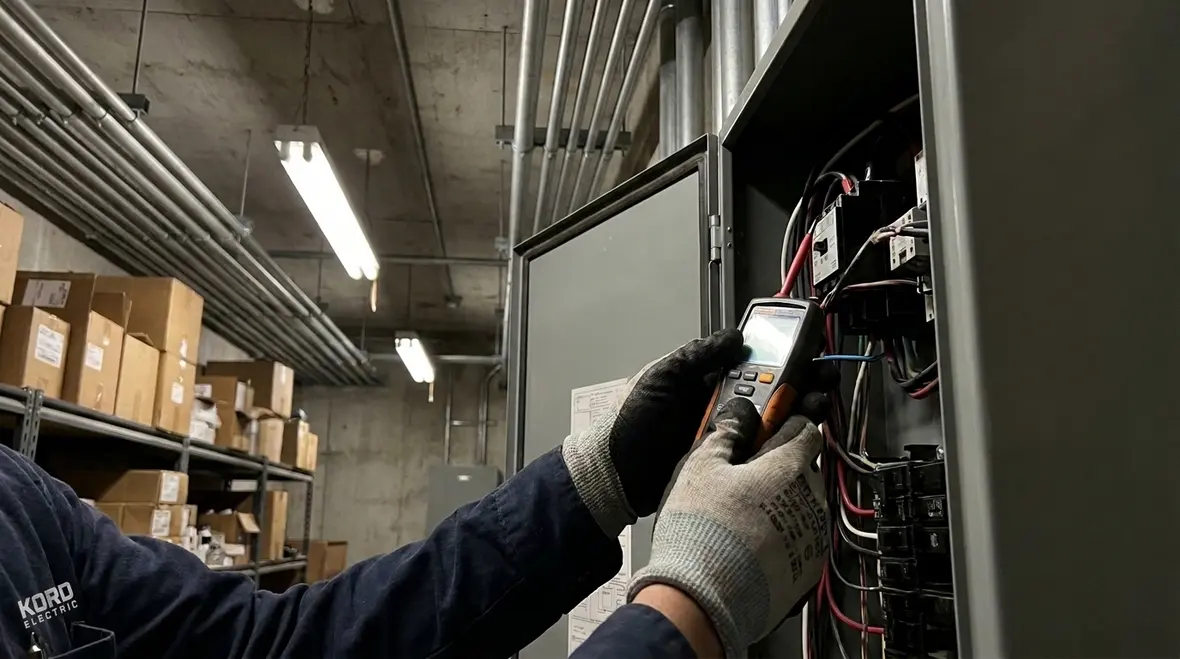
Common Post Installation Electrical Issues in Commercial Buildings
Kord Electric hears the same themes from commercial customers after a new electrical install. First, we often get reports of Common Post-Installation Electrical Issues: Outages, Flickering & Coverage Gaps, especially when a building starts running full schedules. Next, teams notice lights that flicker like they are trying to join a low budget sci fi film. Then, property managers point out coverage gaps where certain areas never quite feel lit the way they should. And yes, sometimes the outage is dramatic, like the power decided to take a vacation without telling anyone.
In this article, we walk through what others commonly report, why it happens in commercial and industrial settings, and how our technicians explain the fix in clear language. We focus on major property buildings and facilities, because that is where reliable power matters most.
Common post install electrical complaints we hear from businesses
After work completes, commercial clients typically report issues that fall into a few buckets. Even when the initial install looks clean, buildings have real life: different loads come online, tenants share power, and schedules change. That means a system can behave one way during testing and another way in the first few weeks.
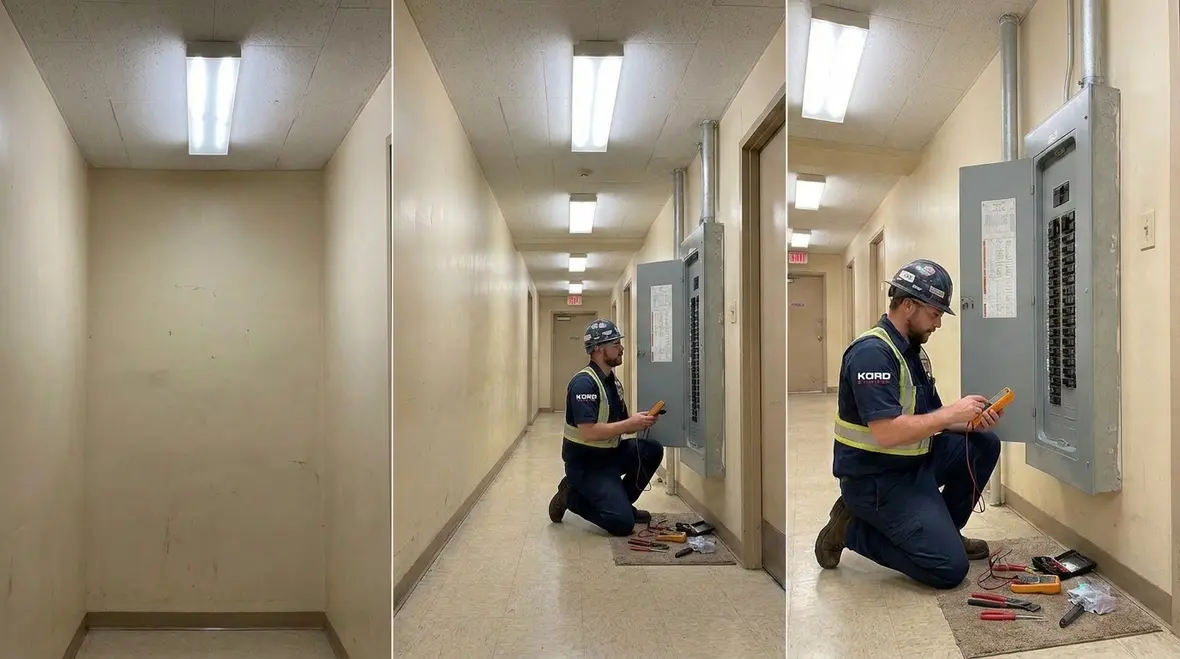
Our expert service staff often hears:
- Outages that show up after hours or during peak use, then vanish after a reset
- Flickering that starts with certain circuits, then spreads when more equipment runs
- Coverage gaps where areas stay dim even though fixtures look correct on paper
- Warm or noisy breakers, especially when dimming or specialty loads exist
- Reports of “it worked yesterday,” which is the most honest way to say the load pattern changed
To be clear, not every complaint means the installer missed something. However, in commercial environments, small issues can trigger bigger symptoms fast. So we approach each call like a detective story, not a blame game.
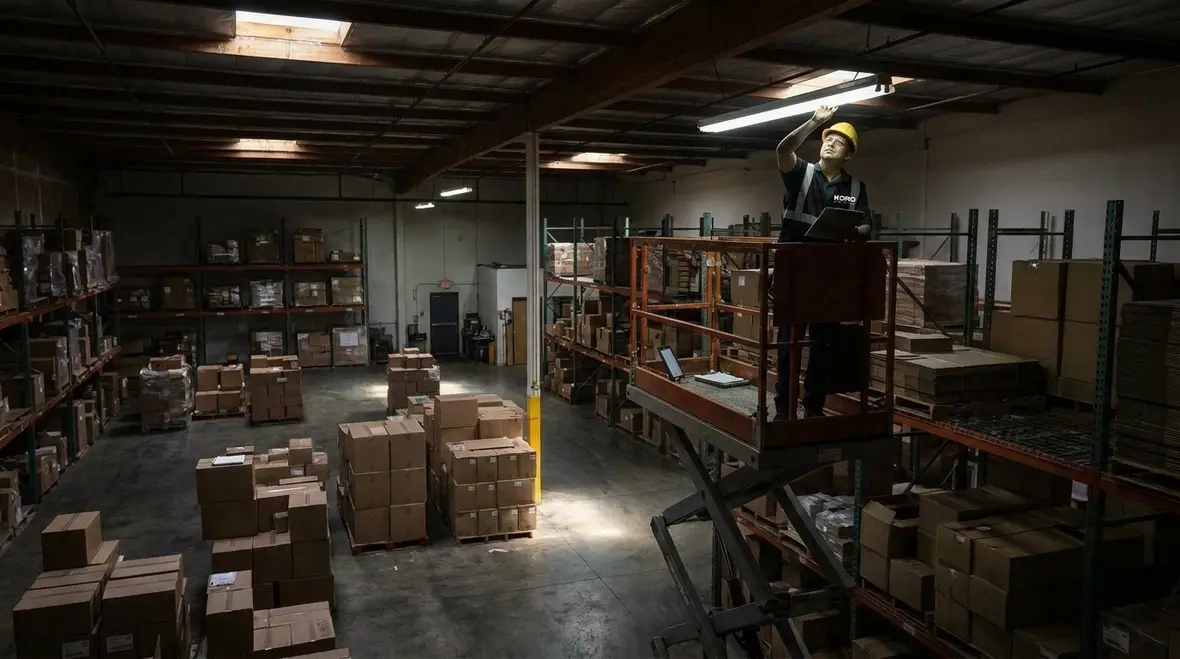
Why outages show up after work is finished
In many facilities, outage complaints do not start with dramatic wiring failures. Instead, they show up when the building’s electrical use changes from testing conditions to daily operations. For example, we might energize a panel while critical equipment runs at low draw. Later, forklifts, HVAC boosters, production lines, or kitchen loads cycle on. Then the system reveals how it handles real current.
Our technicians typically look at several proven causes:
- Branch circuit overloading when multiple tenants or departments share a circuit that was not modeled for peak load
- Loose or stressed terminations that behave fine under light load but heat up under higher current
- Incorrect breaker sizing that trips sooner or holds longer than expected
- Grounding or bonding gaps that increase nuisance tripping and cause voltage instability
- Neutral issues, especially when non linear loads like LED drivers and variable speed drives exist
Then there is the human factor. Facility teams sometimes notice a pattern and assume it is random. Yet, after we listen and review the schedule, the “random” outage often ties to a specific event, like a shift change. And if the staff already has maintenance logs, we can confirm it quickly.
If your building is already showing signs of stress like repeated breaker trips, nuisance shutdowns, or panels that feel warmer than they should, it may be time to look beyond quick resets. In some facilities, those symptoms signal that the overall service or distribution is near its limit. When that happens, we align our troubleshooting with broader planning work such as commercial subpanel electrical services and expansion planning so the fixes support future loads instead of just patching today’s outage.
Flicker after installation: the signals our technicians track
Flickering lights can make people think the building is haunted. Realistically, the cause is electrical behavior, not ghosts. In commercial and industrial buildings, flicker often links to dimming, LED driver characteristics, or power quality issues that show up once the site returns to normal operations.
In our Kord Electric blog post on troubleshooting flickering commercial lights fast, we outline a practical approach we still use on service calls. We check drivers, verify compatibility with dimming controls, and inspect wiring connections for both tightness and correct routing. Additionally, we confirm grounding and neutral stability, because even small voltage swings can affect electronic lighting loads.
Here is what we commonly find when flicker appears after an install:
- Dimming system mismatch where the driver cannot respond cleanly to the dimmer or control signal
- Loose connections that arc slightly under load and create visible instability
- Voltage dips triggered by other equipment starting up
- Overloaded neutrals in panel setups that mix electronic and traditional loads
- Wrong wiring configuration that changes how current returns and how the driver “reads” power
After we find the likely cause, our technicians do not just swap parts and move on. Instead, they explain what they observed, what it means for the building, and how we confirm the fix. We prefer clarity over guesswork, because facilities deserve answers they can repeat to the next person who asks.
In many cases, flicker is the first symptom of a larger pattern. For example, control wiring issues or mismatched drivers can also contribute to coverage problems, nuisance trips, or complaints that lights do not behave consistently from one zone to the next. That is why our team often connects flicker troubleshooting with broader lighting checks based on the same practical methods we describe in our commercial lighting installation planning and best practices guide.
Coverage gaps: why fixtures look right but feel wrong
Coverage gaps are frustrating because the work can appear correct from a quick walk through. A fixture might be installed where plans show it, and yet the space stays dim or uneven. Commercial lighting also has rules beyond “hang the lights and hope.”
Common causes include:
- Incorrect spacing between luminaires compared to the design intent
- Beam angle or optics mismatch where the fixture does not throw light where the space needs it
- Reflections and obstructions like HVAC ductwork, racking, shelving, or signage that blocks light paths
- Wrong mounting height due to field changes after rough-in
- Control zoning errors when panels or switches do not match the intended room layout
Then, we consider workflow. For example, a warehouse might look bright when empty, but coverage changes when pallets and equipment sit in the same positions daily. In offices, glare and shadows can build around workstations as furniture moves. Because of that, we often recommend a short verification routine after install that matches the real layout and use of the facility.
Our expert service staff uses simple checks to prove performance, and we share the findings with the people who manage the building every day. That way, the fix fits the space, not just the blueprint.
How commercial electrical systems evolve after commissioning
Even if the install follows code and passes initial tests, a building changes. People add equipment. Tenants expand. Maintenance teams adjust schedules. So electrical symptoms can appear weeks later, when the system meets a new pattern of demand.
For that reason, our team uses a practical mindset during troubleshooting. First, we review what changed since energization, including equipment additions, control settings, and operating schedules. Next, we check whether the symptom aligns with a particular time window, zone, or load type. Then, we inspect the power path like it matters, because in commercial facilities, it does.
We also consider power quality and how modern devices behave. LED lighting drivers, variable frequency drives, and plug in power systems can respond differently than older loads. Therefore, solutions must match today’s electrical behavior, not just what worked ten years ago.
And yes, sometimes the issue is simple: someone wired a control circuit to the wrong load label. It happens more than people want to admit. However, our technicians treat that as a normal service discovery, not an embarrassment. After all, buildings are complex systems, and complexity is sneaky.
When we track these patterns, we do not look at each outage, flicker, or coverage complaint in isolation. Instead, we connect them to how the entire system behaves. That might mean pairing targeted repairs with larger upgrades, like upgrading commercial electrical service capacity or reworking subpanels so the distribution supports both current and future demands without constant nuisance events.
When to call us for fast, clear service
If your commercial facility experiences outages, flicker, or coverage gaps after an installation, do not wait for a full system failure. Instead, contact Kord Electric early so we can trace the problem while the evidence is still fresh. Transition matters here, because the longer you run with instability, the more likely you are to create secondary damage.
Our process keeps the service focused:
- We ask targeted questions about when the issue happens and what equipment was running
- We inspect the power path, terminations, and control interfaces using job specific context
- We verify lighting performance where coverage gaps appear, not just where it looks fine
- We explain our findings in business language your team can use internally
- We confirm the fix by testing under conditions that match how you actually operate
When we talk with facility managers, we also listen to how they track problems. If they keep maintenance logs, operational hours, or incident reports, we use that data. That speeds up the path to resolution and reduces downtime. In a commercial building, time is money, and electrical problems cost both.
If your facility is already juggling repeated symptoms across multiple panels or tenants, it can help to connect that day to day troubleshooting with a broader plan. Many clients combine our on-site fault finding with a wider review of their Los Angeles County electrical services so that Common Post-Installation Electrical Issues: Outages, Flickering & Coverage Gaps are addressed as part of a stable, long term power strategy instead of a series of one-off emergencies.
FAQ for commercial post install electrical issues
Final word and next step
If your commercial facility shows symptoms after an installation, we recommend acting early. Outages, flicker, and coverage gaps can start as small problems, yet they often grow once the building runs full schedules. Kord Electric brings expert service staff who track causes, explain findings clearly, and verify fixes under real operating conditions. Call us to schedule a diagnostic and get your electrical system back to steady, dependable performance. Because in a business, stability is not a luxury, it is the baseline.
For sites across the region, that diagnostic can also feed into a broader strategy for power reliability, from structured commercial electrical fault finding to long term planning that keeps your panels, lighting, and distribution aligned with how your building actually operates. When outages, flickering, and coverage gaps stop being random surprises and start being managed issues, your team gets to focus on running the business instead of fighting the power system.


