
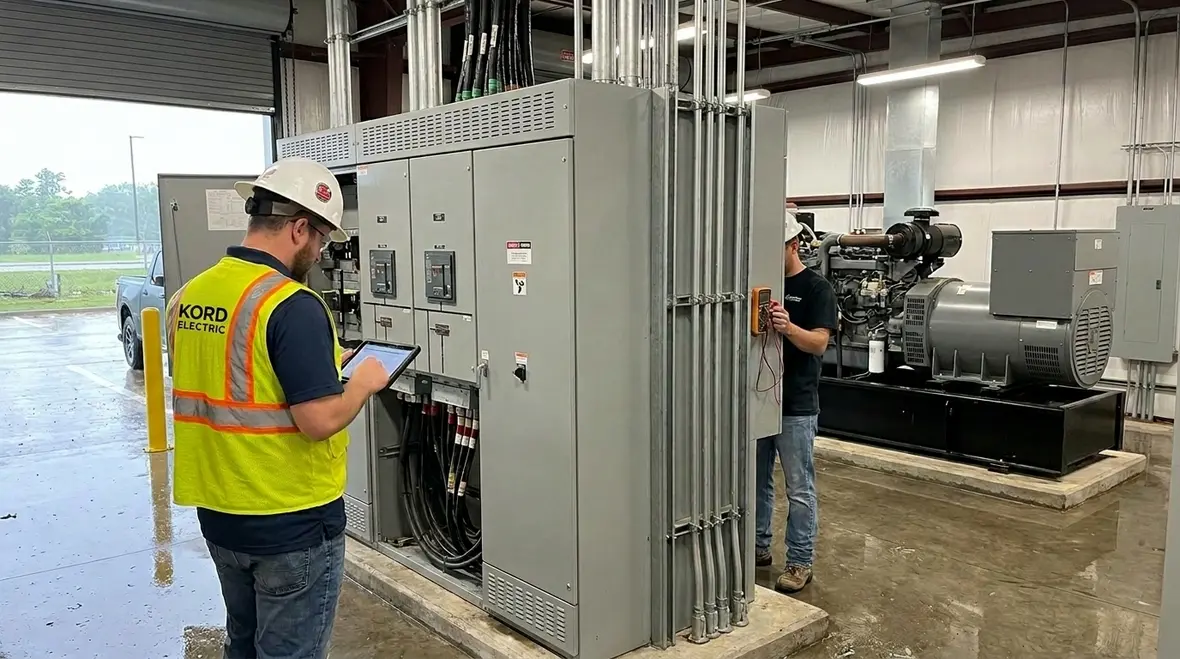
Electrical Infrastructure Disaster Recovery Guide
When storms, outages, or fires hit, Electrical Infrastructure Disaster Recovery decides whether a commercial or industrial site keeps running or goes dark. At Kord Electric, we build resilience into the electrical systems before emergencies happen, and we help restore power with a plan that reduces downtime. Our technicians and expert service staff explain the “why” as clearly as the “what,” because a resilient building is not luck, it is design, testing, and smart change management. And yes, we know power systems can feel like a movie plot no one asked for, but we still help you get to the good ending.
We take a calm, step by step approach to disaster readiness. First, we assess what your facility needs to stay safe and operational. Then, we strengthen the electrical infrastructure so it can handle faults, protect people, and support faster recovery. Finally, we document the details so your team can act quickly when reality shows up, wearing a hard hat and carrying bad news.
Electrical Infrastructure Disaster Recovery starts with risk mapping
Commercial and industrial facilities usually do not fail in one dramatic moment. Instead, risk builds through aging components, poor coordination, and gaps in maintenance. Therefore, our first move is to map the risks that matter to your site: utility drop risk, generator readiness, feeder critical loads, water or humidity exposure, and known weak points such as aging switchgear or outdated protection devices.
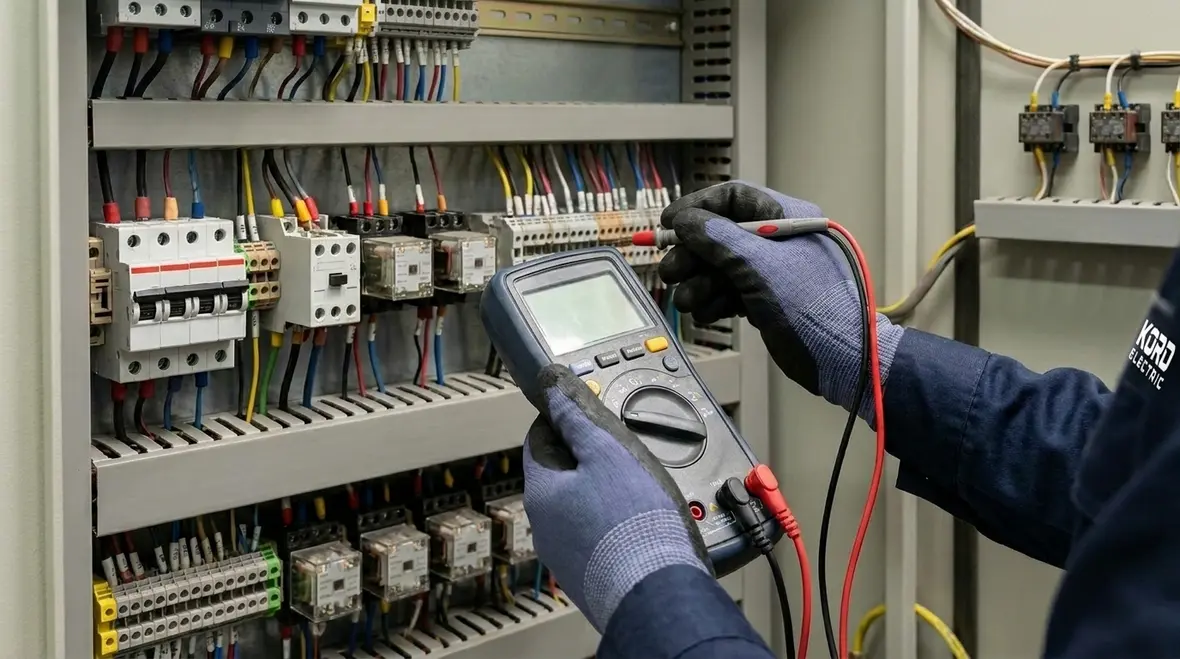
Next, our team reviews how the facility actually runs during stress. For example, some operations need stable power for process equipment, while other areas only need safe shutdown. We also consider how power flows from utility service through switchgear, transformers, distribution panels, and final branch circuits. When we understand that path, we can prioritize upgrades that improve both safety and recovery speed.
To keep things practical, we translate the findings into action levels. Some fixes are quick and high value, like tightening terminations, improving labeling, and correcting coordination gaps. Others require design updates such as adding selective protection or hardening key routes for emergency power distribution.
Build redundancy that actually helps during outages
Redundancy sounds good in a spreadsheet, but it must work in the field. So we design redundancy around real operational needs and code safety rules. Many facilities benefit from redundant feeds to critical switchboards, well planned transfer schemes, and protected distribution for emergency loads.
However, we do not chase redundancy just to collect equipment. Instead, we align redundancy with goals like continued production, safe egress, uninterrupted life safety systems, and faster restoration after a fault. In addition, we look at failure modes. A single point failure in a bus, breaker mechanism, or control circuit can defeat redundancy if it is not addressed.
Our expert service staff often explains this with a simple analogy: if one bridge controls traffic in both directions, you do not have two bridges, you have one bridge with a fancy sign. In other words, redundancy must be separated, tested, and coordinated so it performs under real conditions.
Protection systems should coordinate, not compete
During faults, the electrical system must limit damage and restore service with as little disruption as possible. This is where protection coordination does most of the heavy lifting. We help facilities coordinate overcurrent protective devices so the closest device clears the fault first, and upstream devices remain closed.
To achieve this, our technicians review device ratings, trip settings, time-current curves, and installation details. Then, we verify the system behavior during test plans and field verification. When protection devices do not coordinate, a minor fault can cascade into a bigger shutdown. That is the kind of domino effect that turns a short repair into a long recovery plan.
We also evaluate ground fault protection for the areas where it matters. For example, commercial compliance and safety rules in California often drive how devices are selected and installed for business spaces. If a facility installs these devices without aligning to the needed standards, recovery efforts become harder because troubleshooting takes longer. Kord Electric has covered GFCI outlet compliance in California for commercial settings, and we use that practical knowledge to support safe, predictable protection in the field.
Switchgear and distribution need “survivability” reviews
Switchgear and distribution gear often sit at the center of a disaster response. Therefore, we focus on survivability: how the equipment handles heat, moisture, vibration, and fault energy. We inspect key components like breaker mechanisms, bus bars, insulation condition, control power supplies, and wiring terminations. Then, we verify that labels, schematics, and as-built documentation match what is installed.
In many facilities, documentation is the silent weak link. During an outage, technicians work under time pressure, and missing or outdated drawings turn recovery into guesswork. Our team improves documentation so the next response team can act quickly. We also help set up a system that supports safe troubleshooting, including clear lockout tagout boundaries and test procedures.
Additionally, we plan for how distribution panels and feeders are repaired after damage. We design for service access where possible, and we help reduce the number of steps required to isolate affected sections. As a result, the facility restores power in smaller sections instead of waiting for everything to be replaced at once.
Grounding and bonding keep faults from becoming disasters
In disaster recovery, electrical faults behave like rain in a bad joke: they always find a way to get worse if you ignore drainage. Grounding and bonding create a controlled path for fault current and help protect equipment and people. When these systems fail or drift out of spec, the risk grows for shock hazards, equipment damage, and unstable operation.
We help commercial and industrial sites verify grounding electrode systems, bonding jumpers, and continuity. We also check how grounding interacts with protection devices so fault current clears correctly. If grounding and protection do not align, safety margins shrink. Then, even a small electrical problem can lead to a bigger shutdown than the building needs.
Our technicians also examine environmental factors. Moisture and corrosion affect connections. So we recommend inspection intervals and component upgrades that match the site’s actual exposure. In the long run, these steps reduce the odds of a recovery event turning into a rebuild.
Emergency power planning: transfer, load, and test cycles
Emergency power is not just a generator. It is the whole system: transfer equipment, control logic, fuel readiness, load selection, and testing. We help facilities define critical loads so emergency power supports what truly must stay on, instead of energizing everything and hoping for the best.
Then we review transfer behavior, including interlocks, sequencing, and controls. During a real event, delays or control misbehavior can cause unwanted trips or loss of critical loads. Therefore, our expert service staff builds test plans that reflect how your facility runs. We also verify that test results match expected performance, and we capture outcomes for future response.
Fuel supply, ventilation, and maintenance access matter too. If a generator cannot start under expected conditions, it becomes expensive theater. So we support readiness through scheduled checks, documentation, and clear steps for response teams.
Recovery documentation and training reduce downtime
When an outage happens, people need clear actions, not extra interpretation. That is why we help facilities prepare recovery documents that explain the system in plain language: single line diagrams, panel schedules, device identification, and step by step isolation guidance. We also make sure the documents match the field so your team does not chase outdated drawings.
Next, we train staff and coordinate with facility leadership. Our technicians walk through common scenarios, such as feeder failures, breaker trip events, control power loss, and restoration sequencing after maintenance. We also explain how Electrical Infrastructure Disaster Recovery ties into everyday tasks like maintenance tracking, test records, and the update cycle after equipment upgrades.
To keep morale up during stress, we encourage a simple practice: after every test or repair, log what changed and why. That turns each event into data for the next improvement, not a repeat performance of the same confusion.
Dual-column: practical disaster readiness checklist
Before an event
Map risk by feeder, equipment, and critical load areas.
Verify protection coordination and update settings when needed.
Inspect switchgear, breaker mechanisms, and terminations.
Confirm grounding and bonding continuity and corrosion control.
Define emergency loads and confirm transfer sequencing.
Update schematics and panel schedules to match current equipment.
During and after an event
Use clear isolation steps and labeling for fast triage.
Follow documented test and restart sequences.
Restore critical systems first, then expand restoration in stages.
Record trip causes, replacement needs, and timing outcomes.
Schedule targeted repairs based on damaged sections and root cause.
Run post-event protection and grounding checks before full return.
FAQ: Electrical Infrastructure Disaster Recovery for commercial and industrial sites
Ready for resilience that performs when it counts
Disasters do not wait for perfect conditions. So we help commercial and industrial facilities prepare electrical systems that stay safer, recover faster, and protect critical operations. At Kord Electric, our technicians and expert service staff assess the full distribution path, verify protection behavior, and plan emergency power and recovery steps your team can trust. If you want a practical plan for Electrical Infrastructure Disaster Recovery, reach out today and let us map the risks in your facility and build a roadmap to keep the lights on.
For sites that want to go deeper on preventing unplanned outages, you can explore how Kord Electric approaches emergency power failures in commercial buildings and structured maintenance strategies such as NFPA 70B electrical panels and switchgear maintenance. Together with focused Electrical Infrastructure Disaster Recovery planning, these approaches help turn surprise outages into manageable exceptions instead of recurring storylines.
If your facility is already wrestling with unstable power or sensitive equipment, Kord Electric’s dedicated support for voltage fluctuations in commercial and industrial facilities adds another layer of resilience, keeping recovery work aligned with long-term reliability goals.
When you are ready to connect disaster recovery planning with broader electrical upgrades, Kord Electric’s commercial services can help coordinate everything from targeted repairs to strategic improvements in distribution, lighting, and emergency systems so your infrastructure becomes calmer and more predictable over time.
For hands-on project support, explore their specialized service options such as recessed lighting installation or other commercial electrical solutions that can be integrated into your overall resilience strategy.


