Emergency Power System Testing and Validation
Kord Electric works with commercial and industrial facilities where lives, operations, and major assets depend on backup power. For us, Emergency Power System Testing and its validation is not a paperwork exercise. It is the difference between “it should work” and “it does work” when alarms, smoke, or storms show up uninvited. And yes, we have heard the old line that equipment “usually performs fine.” Usually is a dangerous word in emergency power, kind of like saying you will pay your invoice “eventually.”
In this guide, our expert service staff explains the essentials of reliable testing, using plain steps and practical checks. We also align our approach with the intent behind the National Electrical Code and the NFPA standards, including the guidance discussed in our Kord Electric blog about NFPA 70 for 2026. Then we connect those rules to what technicians actually verify on site.
Plan testing around real operating conditions
When our technicians plan Emergency Power System Testing, they start with how the building actually runs. That means the test plan follows normal load behavior, critical loads, and the way transfer and startup happen under site constraints. For example, a data hall and a manufacturing line do not fail in the same way, so they do not need the same test method.

First, we review system design documents, last test results, and change logs. Next, we confirm that any recent upgrades, tenant power changes, or control panel modifications have been recorded. Then we build the test sequence so it reflects the normal emergency path. This keeps the process safe and avoids testing parts of the system in ways that look good on paper but do not represent what will happen during an outage.
Finally, we coordinate the schedule with operations and safety teams. In many commercial and industrial facilities, downtime windows are tight. Therefore, a solid plan protects production while still exercising the system the way it will be called during an emergency.

Validate compliance with code intent, not just checklists
Many teams treat testing like a box on a form. We treat it like proof. That is how we reduce the risk that equipment “passes” a superficial test yet fails under stress, voltage dips, load pickup, or signal delays.
Our approach considers the intent behind NFPA guidance and the electrical code framework described in our article about NFPA 70 and the 2026 updates. Specifically, we focus on safe installation, correct equipment ratings, proper labeling, and correct coordination between power sources and transfer devices. Then we confirm the system works as designed across the full emergency sequence.
In the field, our expert service staff also pays attention to how control wiring and sensing points behave. A transfer relay might switch cleanly at idle, but it can misbehave when voltage levels shift or when load conditions change. So we verify performance under conditions that mirror real emergency demand, not only light conditions.
Test sequence accuracy for transfer and startup
Reliable emergency power depends on timing and correct order of operations. Therefore, our Emergency Power System Testing includes more than “start the generator, then flip the switch.” We verify the chain: detection, signal paths, transfer command, generator startup, load pickup, and stabilization.
To do this well, we monitor key signals during each step. That includes engine start behavior, transfer device timing, and the transition between normal and emergency sources. If the sequence includes a time delay, we confirm that delay matches the system design. If the system uses a controller with adjustable logic, we confirm the settings match the as-built configuration.
Then we verify that protection settings behave correctly. We check that overcurrent, voltage, and frequency protections respond in the right range. In other words, we want the system to protect equipment without tripping in normal emergency operation.
And yes, the transfer process should not feel like a pop song where everything hits at once, then mysteriously goes silent. It needs to be predictable every time, with stable outputs and correct signaling.

Measure load pickup and system stability with real data
At Kord Electric, we know that a generator can start and still fail to support a facility. That is why we confirm load pickup performance and stability during tests. We evaluate how quickly the system accepts load, how voltage stays within expected limits, and how frequency behaves during stabilization.
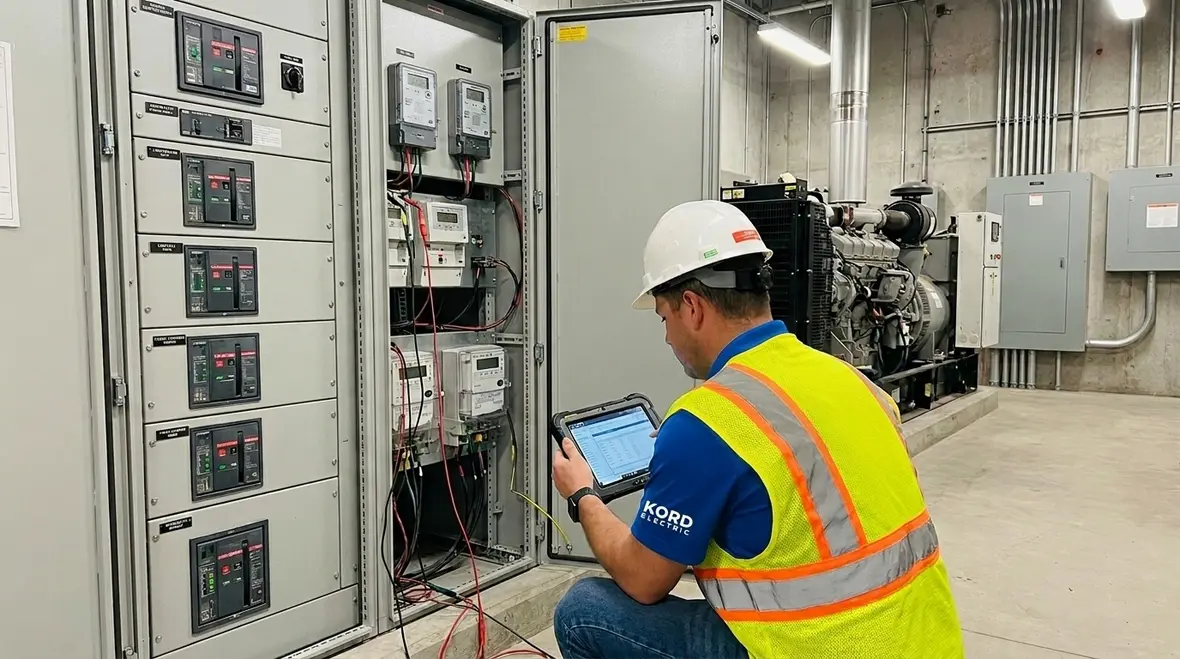
Our technicians use calibrated instruments to capture test data. We track voltage regulation, phase balance where relevant, frequency stability, and run behavior under the facility’s critical load profile. Next, we compare the results to design targets and prior test records.
We also check for signs that show up only under load. That includes abnormal current draw, unstable voltage, overheating indicators, or controller alarms. Then we record findings clearly so the next test can improve, not repeat guessing.
For larger commercial and industrial sites, this becomes even more important because loads vary and some critical equipment starts in a heavy sequence. So we coordinate the test with the facility’s power priority needs, ensuring the emergency system handles what matters most.
Validate batteries, chargers, and protective monitoring
Many teams focus on the generator and forget the supporting cast. In reality, batteries, chargers, and monitoring systems often decide whether the generator starts when it must. Our technicians validate that portion of the system with the seriousness it deserves.
During Emergency Power System Testing, we inspect battery health, verify charger operation, confirm alarm thresholds, and confirm wiring integrity at the control and monitoring panels. We verify that the battery system supplies the required voltage for the startup sequence and that it recovers as expected after the test load demand.
Next, we check protective monitoring signals that feed building alarms and controls. If a fault signal should trigger a specific event, we confirm it does. If a maintenance alert should display only under certain conditions, we confirm the logic works correctly.
This step prevents silent failures. Because when a facility depends on emergency power, “it should alert us” is not a strategy. It needs to actually alert us, at the right time, in the right way.
Document results and use them to improve the system
Testing without good documentation creates a false sense of control. Kord Electric builds reports that technicians and facility managers can use. We provide a clear record of what we tested, what we measured, what the system did during each phase, and any deviations we observed.
Then we translate results into actions. If we find a timing mismatch, we flag it. If voltage regulation looks out of range, we recommend next steps. If alarms show patterns, we identify where the system behaves differently than expected.
We also set expectations for retesting and corrective work. That matters because the next cycle of Emergency Power System Testing should start from lessons learned, not repeat old issues like a rerun episode that nobody asked for. In business and industry, every unnecessary outage costs money, and every unclear report costs time.
Below, we provide a simple dual-column overview of what our technicians validate during site testing.
What we verify
Transfer timing and sequence
Generator startup and stabilization
Voltage, frequency, and load pickup
Protection behavior under load
Battery and charger readiness
Alarm and monitoring signal paths
Why it matters
Ensures emergency handoff works
Prevents failed startup under demand
Confirms safe electrical output
Stops damage while supporting critical loads
Protects the starting system
Enables the right response during events
How we communicate with facility teams during testing
Testing works best when operations feel informed and safe. Therefore, our expert service staff communicates the plan before we energize, coordinate during the sequence, and debrief right after we finish. We keep the tone professional and the details practical, because facility leaders do not need mystery, they need clarity.
We also explain what each measurement means in plain language. For instance, we do not just say voltage drift occurred. We explain whether it affects sensitive equipment and what it likely indicates in control or generator regulation systems. And when we recommend changes, we tie those recommendations to system reliability for commercial and industrial buildings.
To keep everyone aligned, we may include a short walk-through of findings on site. That lets facility staff confirm physical conditions and understand next steps without waiting for a long explanation later.
For facilities looking to formalize long-term strategies, our approach to Emergency Power System Testing fits naturally alongside structured programs like our Electrical Preventive Maintenance services and other commercial and industrial maintenance plans.
FAQ: Emergency power system testing and validation
Conclusion: Get reliable validation with Kord Electric
If your facility depends on emergency power, you deserve testing that proves performance, not testing that just “checks the box.” Our technicians plan the sequence, measure stability under realistic demand, validate controls, and document results in a way your team can act on. For commercial and industrial buildings, reliability is a business requirement, not a hope. Contact Kord Electric today and let us build an Emergency Power System Testing and validation plan that stays ready when events show up, on time or not.
For organizations that want a broader strategy around reliability, consider pairing emergency power testing with structured programs like our Electrical Preventive Maintenance services, or explore related guidance in our article on Commercial and Industrial Electrical Maintenance Plans. Together, these approaches help keep critical systems online and aligned with the latest code intent.
If your facility is planning upgrades or new infrastructure, our dedicated Electrical Preventive Maintenance and related commercial and industrial services provide a strong foundation for safe, compliant, and resilient power systems that support Emergency Power System Testing over the long term.