Commercial Building Lighting Maintenance Preventive Guide
At Kord Electric, we take commercial lighting maintenance seriously, because in real life, light systems do not “self-heal” and bulbs do not file warranties early. In our Commercial Building Lighting Maintenance: Preventive Maintenance Guide, we lay out a practical plan for keeping fixtures, controls, wiring, and safety devices operating as designed. First, we inspect and document what is already there. Then, we clean, test, and tune the system before small problems become big ones. Finally, we schedule follow ups so performance stays steady across weeks, months, and seasons.
In this article, we explain how our technicians and expert service staff approach preventive lighting work for commercial and industrial facilities and major property buildings. Along the way, we keep it clear, calm, and a little bit funny, because nobody wants a ten page lecture about lumens. Still, the steps matter, and the results show up on your energy bill, your maintenance logs, and your tenant experience.
Why commercial lighting failures cost more than you think
When lighting runs poorly, the impact travels fast. Tenants notice first, then supervisors do, and then maintenance requests pile up like laundry you forgot in the dryer. However, the real cost is usually less obvious. Flicker can reduce comfort and slow productivity. Poor illumination can increase safety risks. And if a fixture fails at the worst possible time, operations lose time and staff spend hours chasing the source.
Therefore, preventive maintenance is not just about replacing parts. It is about catching the early signals: early lamp degradation, ballast or driver stress, loose connections, water or dust infiltration, and control misbehavior. In fact, our team often finds that what looks like “one dead light” actually links back to a systemic issue in the circuit, the control panel, or the fixture housing.
And yes, it can be frustrating. Even the most loyal employee will eventually ask, “Why is this light acting like it is haunted by a sitcom ghost?” We respond with testing, documentation, and repair plans, not guesswork.
For facility managers who also track energy performance, pairing this approach with a structured checklist like the one in Kord Electric’s Commercial Lighting Maintenance Checklist Guide helps connect day-to-day lighting issues with long term savings and reliability records.
How technicians build a lighting maintenance plan that actually holds up
Our approach starts with understanding the building and the lighting layout, not just the equipment labels. Next, we map critical zones such as entrances, parking areas, hallways, stairwells, loading docks, and interior spaces where tasks happen daily. After that, our technicians focus on risk, runtime, and operational impact. Some areas can tolerate slower service. Other areas cannot, because people move through them and work depends on stable lighting.

Then we build a schedule that matches your usage. For example, a facility that runs long shifts in summer needs different attention than one with short hours and seasonal shutdowns. As a result, we can prioritize cleaning, optical maintenance, and electrical checks when they will deliver the most benefit.
Throughout the process, our expert service staff explains each step to facility managers in plain terms. We show what we tested, what we found, and what it means for safety and performance. You get clarity instead of a mysterious “we checked it” stamp. And if we recommend a change, we explain why, along with the expected outcome.
When a building needs more than lighting care, we often align these routines with broader electrical strategies, such as the programs described in Kord Electric’s Commercial and Industrial Electrical Maintenance Plans, so the lighting system and power infrastructure support each other instead of drifting apart.
What Commercial Building Lighting Maintenance: Preventive Maintenance Guide includes
In our guide, we cover the full system. We do not treat lighting like a pile of separate bulbs. We treat it like a network that includes fixtures, drivers, ballasts, wiring, controls, and sometimes emergency and life safety components.
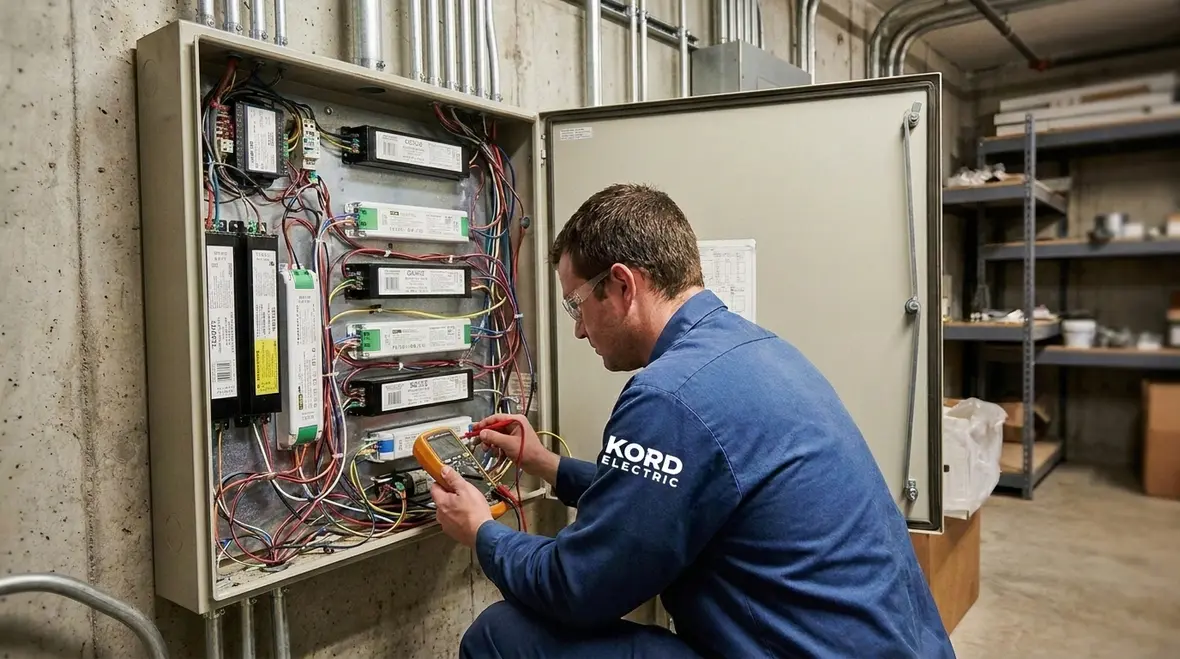
First, we inspect and verify the condition of fixtures and housings. We check for dust buildup, moisture intrusion, cracked lenses, and loose mounting. Next, we clean optics and reflectors to protect output and reduce hot spots. Then we test electrical connections and look for signs of overheating.
Finally, we verify controls operation where applicable. That includes scheduling, dimming behavior, occupancy or daylight sensors, and panel settings. If your controls drift from their intended pattern, energy savings and comfort both take a hit. Therefore, our Commercial Building Lighting Maintenance: Preventive Maintenance Guide emphasizes control verification, not just fixture replacement.
And because buildings rarely stay still, we update the plan as things change. New tenants move in. Renovations happen. Lighting zones shift. We adjust the maintenance routine so the system stays stable after the next change request.
When properties are also considering upgrades, our team can connect this preventive guide with retrofit strategies like those in Kord Electric’s Office Building Lighting Energy Upgrades Guide, so maintenance and upgrades share the same playbook.
Fixture and optics care that keeps output steady
Here is the part people underestimate. Dust, smoke residue, and dirt on lenses reduce light output even when lamps still “work.” Over time, a space can feel dim, even if no one can point to a single failed component. Consequently, the building owner may blame aging lamps, but the optics might be the bigger story.
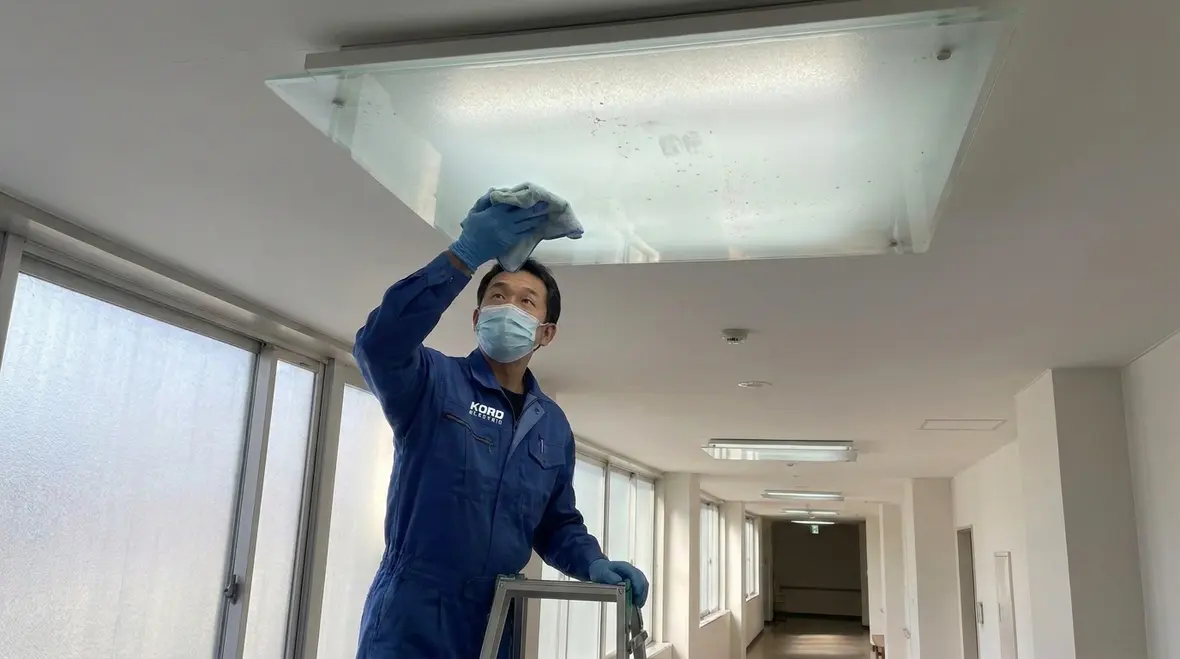
Our technicians clean and inspect optics with the right approach for each fixture type. We take care with fasteners, seals, and alignment so the fixture does not shift after service. We also look for signs of water exposure, especially around loading areas, exterior soffits, and places where HVAC or weather effects create condensation.
Then we address uniformity. If one section of a corridor looks brighter than the next, that often traces back to dirt levels, lens differences, fixture wattage variation, or control tuning. We help standardize performance where it matters, so your spaces look consistent and feel professional.
In other words, we make sure the lighting does not just exist. We make it behave.
For facilities exploring energy-focused projects alongside cleaning routines, the same inspection that reveals dirty optics can also highlight candidates for upgrades using resources like Kord Electric’s Energy Efficient Commercial Lighting Retrofit, helping teams combine efficiency gains with reduced maintenance calls.
Electrical checks and controls verification for reliability
Lighting failures usually start small. A loose connection heats up, then a driver or ballast gets stressed, then performance drops. Meanwhile, controls can misread occupancy, dim at the wrong times, or lock into incorrect schedules. As a result, you may see flicker, unexpected outages, or zones that never reach the needed brightness.
To prevent this, we run targeted electrical checks during maintenance visits. We look at connection integrity, signs of thermal stress, and circuit conditions. We also verify that drivers and ballasts operate within expected behavior. When we find wear, we plan repairs in a way that protects both uptime and safety.
On the controls side, we verify settings and operation for dimming and scheduling systems. We confirm that sensors respond properly and that daylight behavior does what it is supposed to do. Moreover, we cross check control logic with actual occupancy patterns. That means we consider how employees move, how doors open, and how work changes throughout the day.
Sometimes we get a call because someone says the lights “turn off too fast.” Then we check the occupancy sensor settings, time delays, and placement. Once we adjust them, the building stops acting like a mystery novel where every chapter ends with darkness.
Because these electrical checks tie directly into broader system health, many facility managers pair them with Kord Electric’s Commercial Electrical Preventative Maintenance Checklist so both lighting and power distribution follow the same preventive rhythm.
Scheduling preventive work to cut downtime and surprises
Preventive maintenance works best when it fits how your building operates. We coordinate service windows that protect production, customer traffic, and safety routines. In many commercial and industrial facilities, work happens around shift schedules and critical operations. Therefore, we plan visits to minimize disruption and we communicate what we will do, when we will do it, and what downtime to expect, if any.
We also coordinate with other trades when needed. If your site is undergoing upgrades, we align our lighting work with those timelines. This reduces repeat access and keeps service documentation clean.
Additionally, we track what we found and what we corrected. That way, the next visit uses history, not guesswork. Over time, this turns maintenance into a controlled process instead of a reactive scramble. The goal is simple: steady illumination now, and fewer emergency calls later.
To show how our scheduling supports decision making, we sometimes present the plan like a two sided view for facilities teams: what the building needs now and what we will target next. Here is a quick snapshot of that style of thinking, with a dual view.
Immediate focus
|
Planned focus
|
For larger portfolios, this scheduling model aligns naturally with Kord Electric’s Commercial Preventative Maintenance Programs, which turn one building’s routine into a repeatable standard across multiple sites.
What the service staff explains during maintenance visits
After each preventive visit, we make sure your team understands the results. Our technicians and expert service staff explain findings with direct language. We share what contributed to performance changes, how control behavior affects output, and which components show wear.
We also explain the “why” behind recommendations. For example, if we suggest cleaning a set of fixtures, we explain the expected impact on illumination and uniformity. If we recommend electrical attention, we connect it to reliability and safety. And if we propose controls tuning, we explain how schedules and sensor settings influence energy use and comfort.
We know that many facility managers juggle budgets, tenant needs, and compliance concerns. So we keep the discussion grounded in operations. And yes, we sometimes hear jokes like, “Just turn them all off and save money.” We smile, then we build a plan that saves money without turning your building into a cave.
For properties in Los Angeles County and nearby regions, these conversations often lead naturally into broader solutions like Kord Electric’s Los Angeles County commercial and industrial electrical services, so lighting maintenance links directly to the rest of your electrical needs.
FAQ
How often should commercial buildings receive lighting preventive maintenance?
Most commercial and industrial facilities benefit from scheduled checks at regular intervals, often quarterly or semi annually, depending on usage, environment, and equipment age.
What problems do technicians catch early during maintenance?
They typically find early signs like overheating at connections, dirty optics that reduce output, failing drivers or ballasts, moisture issues, and control misbehavior.
Does cleaning fixtures improve brightness or only appearance?
Both. Cleaning optics and lenses can restore light output and improve uniformity, which supports comfort and task performance.
Can lighting controls cause maintenance problems?
Yes. Incorrect schedules, faulty sensor placement, or timing settings can cause flicker, premature dimming, and unexpected outages.
Do you serve only commercial and industrial sites?
Yes. Kord Electric focuses on commercial, industrial, and major property buildings, where lighting reliability and uptime matter most.
What documents do you provide after service?
We share what we inspected, what we found, and what we corrected, so your facilities team can track improvements and plan next steps.
Ready to protect your uptime and lighting performance
If your commercial or industrial building depends on reliable lighting, then preventive maintenance is the calm, smart choice. Kord Electric brings expert technicians, careful inspections, and a clear Commercial Building Lighting Maintenance: Preventive Maintenance Guide approach that reduces surprises and supports consistent illumination. Contact us today to schedule a lighting maintenance assessment for your facility. We will review your zones, explain our findings, and recommend the next steps that fit your operations and timeline.
When you are ready to connect this guide with a broader preventive strategy, you can also explore Kord Electric’s Commercial Lighting Maintenance Checklist Guide, which pairs well with this Commercial Building Lighting Maintenance: Preventive Maintenance Guide and gives facility managers a practical, checklist style companion.
For organizations in and around Los Angeles County, our dedicated Los Angeles County electrical services team can turn this maintenance guide into a structured on-site program, from routine lighting checks to coordinated electrical preventive maintenance across panels, feeders, and critical loads.