Commercial Switchgear Preventive Maintenance Plan
Commercial switchgear preventive maintenance made practical for busy facilities
Kord Electric helps commercial and industrial facilities keep power equipment dependable, and we do it by building clear Commercial switchgear preventive maintenance schedules. In our experience, switchgear failures do not usually start with fireworks. They start with small issues: dust in the wrong place, heat where it should not be, moisture that quietly creeps in, and parts that slowly lose their tolerance. Then one day the facility manager hears a tripping event, and the building reacts like it just stepped on a LEGO. Nobody enjoys that.
In this guide, our team explains how we plan maintenance work, how we set timeframes, and what technicians actually check. You get a full schedule blueprint, plus the testing steps that reduce risk while keeping your operation running.
What we mean by a preventive maintenance schedule that actually works

A strong preventive program does not “cover everything” in theory. Instead, it follows a repeatable rhythm that matches how your facility uses the switchgear. Therefore, Kord Electric builds schedules that fit commercial and industrial sites such as offices, hospitals, universities, data centers, warehouses, and major property buildings.
Our expert service staff typically starts with three inputs. First, we review manufacturer recommendations and nameplate data. Next, we analyze the site’s load profile, operating hours, and event history. Finally, we confirm access needs such as shutdown windows and safety boundaries.
Then we translate that into practical steps. We include visual inspections, mechanical checks, electrical testing, thermography, and lubrication when it applies. We also document findings in a way that supports decisions, not guesswork. So when others ask what needs attention next, the answers come from evidence, not vibes.
If your facility team wants deeper context on how a structured plan supports long term reliability beyond switchgear alone, you can also explore how broader commercial and industrial electrical maintenance plans keep panels, feeders, and protective devices aligned with real world operating conditions across large properties and campuses.
Base the schedule on risk, duty cycle, and operating conditions
Not all switchgear faces the same stress. Consequently, we create different maintenance frequencies based on how hard the gear works and what the environment does to it.
1) Duty cycle and load type
Facilities with frequent switching or heavy starting loads experience more wear. For example, a warehouse with constant motor cycling often needs tighter checks than a steady office load. Moreover, variable speed drives and harmonics can increase heat stress even when total current looks “normal.”
2) Environmental conditions
Dust, humidity, corrosive gases, and temperature swings all influence insulation health and contact condition. Therefore, a coastal building or a facility near production areas may require more frequent inspections and cleaning.
3) Age and history
Older systems or units with prior faults need closer attention. If test results showed high contact resistance before, we do not wait another year to look again. We adjust the schedule to protect reliability.
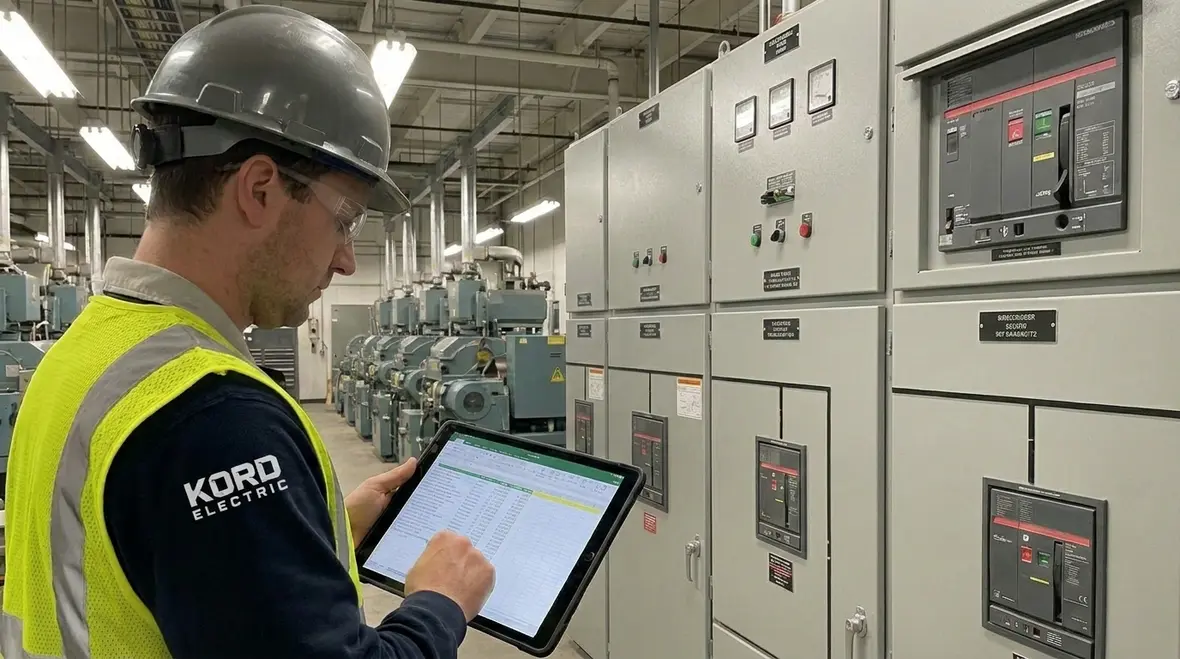
For facilities that also juggle broader electrical risks beyond switchgear, Kord Electric shares how hidden issues in panels, feeders, and distribution equipment can develop quietly over time in their article on hidden electrical risks in commercial buildings, which pairs naturally with a focused switchgear maintenance strategy.
Annual, semi annual, and quarterly checkpoints that keep power steady
Below is a schedule framework Kord Electric uses for commercial and industrial switchgear. It is not a one size plan. However, it gives a clear path that our technicians tailor after they learn how the gear behaves in your building.
Quarterly activities
- Verify proper enclosure condition, latches, seals, and ventilation openings
- Inspect for water intrusion, abnormal dust buildup, and signs of corrosion
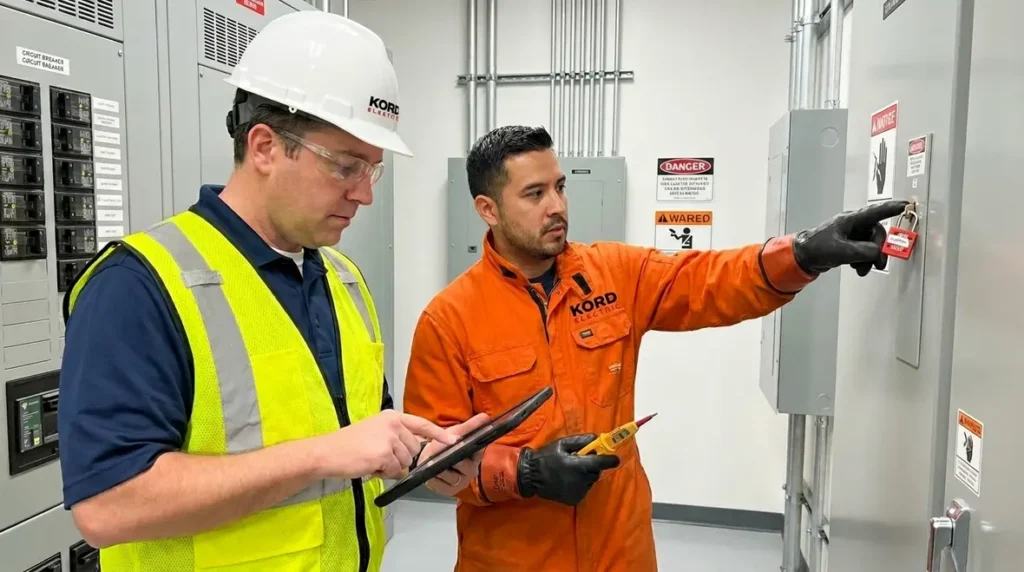
- Check labeling and arc flash boundaries so others do not “borrow” access
- Review event logs and alarms from the protective devices and breakers
Semi annual activities
- Clean critical areas using approved methods to reduce conductive contamination
- Inspect breaker mechanisms for smooth operation and correct alignment
- Verify control wiring appearance, terminations, and insulation condition
- Perform basic functional checks of control circuits when feasible
Annual activities
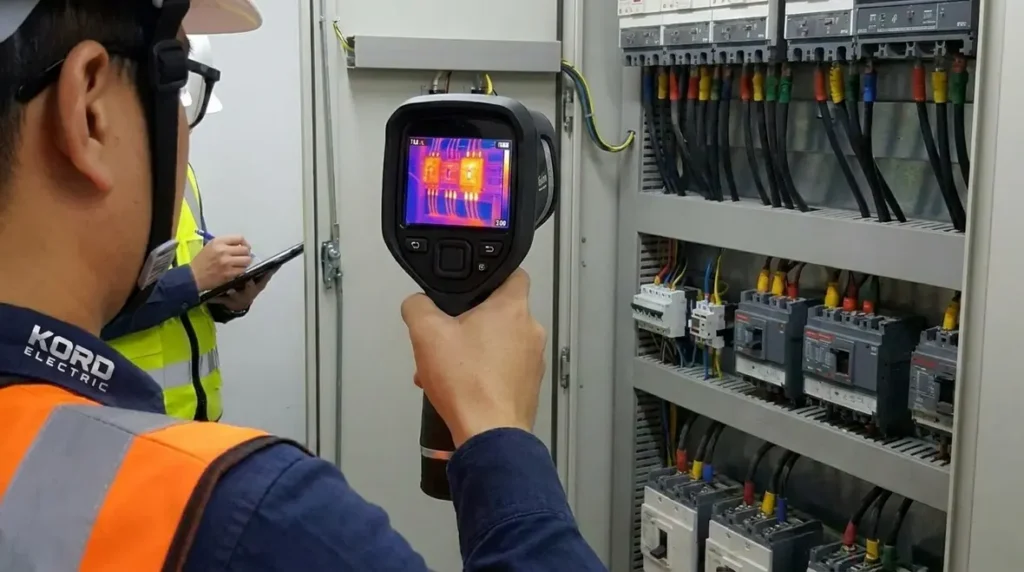
- Thermal imaging during load conditions to spot abnormal hot spots
- Electrical checks that support contact health and insulation integrity
- Mechanical inspection of contact wear indicators and interlocks
- Breaker operations testing with attention to timing and consistency
Every 3 to 5 years, deeper work
- Targeted inspection of key components such as primary contacts, support hardware, and seals
- Reevaluation of protective relay settings and coordination approach when needed
- More detailed testing based on condition results and manufacturer guidance
In our field work, we often hear, “We did something last year, so we are good.” That logic works great for saving receipts. It does not work great for switchgear. Therefore, the schedule above creates consistency, while still allowing condition-based adjustments.

When you want these checkpoints aligned with published best practices, Kord Electric also offers NFPA 70B focused guidance in their article on NFPA 70B electrical panels and switchgear maintenance, which explains how preventive tasks turn into a compliant, documented routine instead of one-off visits.
How technicians build the inspection checklist and what they verify
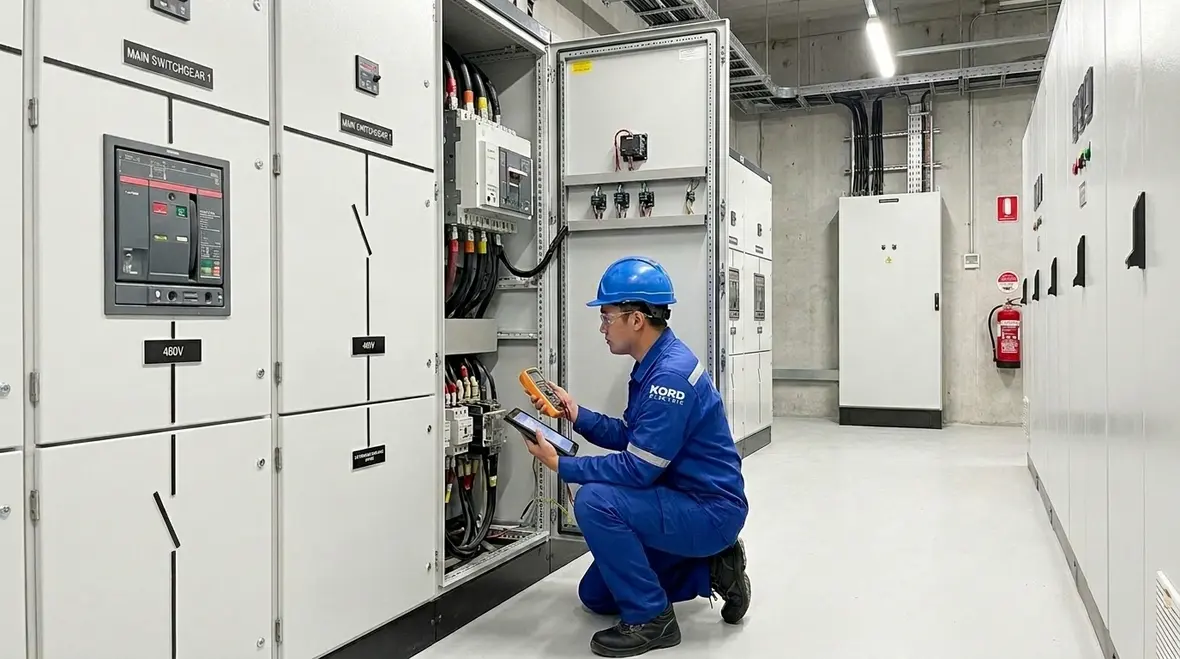
Our expert service staff does not rely on a copy paste checklist. Instead, we use a structured process that matches the switchgear type and your facility needs. We also explain what we find in plain language, because maintenance should not feel like a magic trick.
Visual and mechanical verification
Technicians inspect enclosures for damage, verify mechanical latching, and confirm that barriers and covers are in place. They also check breaker mechanism operation, linkage condition, and spring performance. If a mechanism feels sluggish, we treat it as a signal, not a minor inconvenience.
Electrical testing and control health
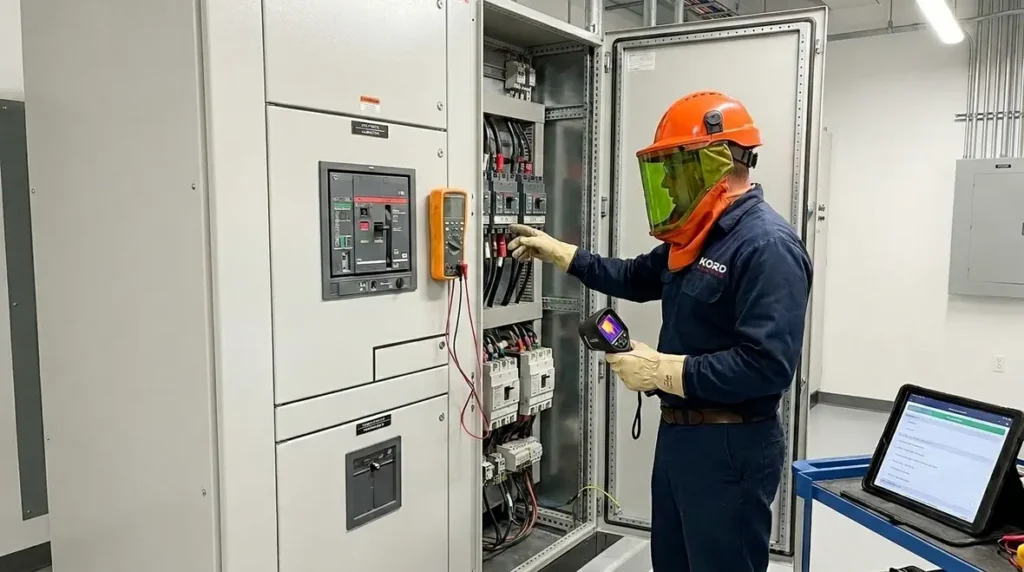
Next, we focus on electrical performance indicators. This can include insulation resistance checks, contact resistance evaluation, and control circuit verification. Then we verify that protective device signals behave correctly and that wiring terminations remain tight and clean.
Thermal imaging plays a major role as well. It helps others see where heat concentrates during actual operation, which can point to loose connections or degraded contacts before they turn into a failure.
Documentation and follow up actions
We track results with clear pass and fail criteria. Additionally, we list corrective actions by priority and estimated impact to uptime. So the next meeting with stakeholders stays focused: what to do, why it matters, and when it should happen.

For facilities that want those inspection findings folded into a wider preventive program, Kord Electric’s electrical preventive maintenance services turn switchgear data, panel readings, and field notes into an organized maintenance roadmap that supports compliance, uptime, and long term equipment life.
Testing gaps, common failure points, and how we reduce them
Switchgear failures often share a pattern. They start with slow degradation, then a heat or moisture event accelerates the damage. After that, the protective devices may trip, and operations lose time like a commuter missing the train they swore they would catch.
Common failure points we watch
- Loose connections that heat up under load
- Contamination that bridges insulation surfaces
- Moisture intrusion that affects control and insulation
- Breaker mechanism wear that changes timing and performance
- Control wiring issues that create intermittent alarms
How scheduling prevents gaps
Commercial and industrial facilities change. Therefore, maintenance schedules must include reminders tied to operating shifts, seasonal environmental changes, and equipment utilization. When others ask why their schedule adjusted, we explain it plainly: the site conditions changed, and the risk profile shifted with them.
Also, we avoid waiting for symptoms. Instead, we plan inspections and testing so that the earliest signs become obvious, measurable, and actionable.
Commercial switchgear preventive maintenance plan for facilities with tight uptime
Many major property buildings cannot shut down whenever we want. So Kord Electric designs a plan that protects uptime while still covering the essential checks. Our approach typically includes staged work, clear shutdown windows, and safety coordination.
Practical scheduling strategies
- Plan testing during low load periods or during planned maintenance nights
- Use coordinated isolation steps so critical feeders remain stable
- Sequence tasks by dependency so crews do not sit idle
- Prepare replacement parts in advance when past findings show repeat issues
Why clear communication matters
In the field, we talk with facility managers, electrical supervisors, and safety teams before we start. Then we document each step so others can track progress. That means fewer surprises, fewer rushed handoffs, and fewer “Why is the panel open?” moments that make everyone stare at the same clipboard.
For data centers and other environments where uptime metrics rule every decision, Kord Electric also shares detailed insight into data center electrical requirements for uptime, showing how switchgear maintenance fits into a larger chain that includes UPS systems, feeder paths, and redundant power strategies.
FAQ
Schedule your switchgear maintenance with Kord Electric
If your facility relies on stable power, you deserve a clear, documented plan that matches real operating conditions. Kord Electric designs and supports preventive maintenance programs for commercial and industrial buildings, and our technicians explain every finding in plain terms. Let us review your switchgear type, usage, and history, then build a schedule that protects uptime and reduces risk. Contact Kord Electric today to set up an assessment and get a practical maintenance roadmap your team can trust.
When you are ready to build that program into a broader service relationship, Kord Electric’s dedicated electrical preventive maintenance services give you a structured way to coordinate Commercial switchgear preventive maintenance with panel inspections, infrared scans, documentation support, and recurring visits that respect how your building actually runs day to day.