Emergency Power Business Continuity for Commercial Sites
At Kord Electric, we see emergency power business continuity as the quiet backbone of commercial and industrial life. When utilities fail, it is not only the lights that go dark. It is billing systems, ventilation, refrigeration, security, and the calm ability to keep serving customers instead of filing incident reports. And yes, downtime can feel like a surprise boss fight. Still, we treat it like a planned event: prepare early, test often, and staff every step with expertise.
Others might budget for the equipment and hope for the best. We focus on the full cost of interruption, because the real bill often arrives after the outage ends, when teams scramble and leadership asks the dreaded question: why didn’t we protect the margin we promised?
The real cost of downtime for commercial sites
In commercial and industrial facilities, downtime rarely stays in one lane. First, production slows. Then work stops. Meanwhile, the clock keeps running on staffing, overtime, contract penalties, and missed service levels. Even short outages can trigger cascading failures, especially for systems that require power stability.
We often hear, “It’s only a few hours.” Then our technicians explain what happens inside those hours. Refrigeration warms. Safety monitoring pauses. Elevators and access control behave inconsistently. And when the power returns, some systems do not restart cleanly, which means the outage becomes a multi day recovery instead of a quick reset. That is where cost multiplies.
To keep the business healthy, Kord Electric evaluates downtime as a total picture, not a stopwatch event. We look at revenue impact, labor disruption, equipment wear, data risk, and customer trust. In other words, we treat downtime like a leak, because if you only patch the visible drip, the floor keeps getting wet.

If your facility leadership wants to dig deeper into how outages start and spread across a property, you can also explore how emergency power failures in commercial buildings happen when maintenance, testing, or load planning falls behind.
Why emergency power changes the math
When a facility installs and maintains a reliable emergency power system, the biggest change is predictable operation. Instead of scrambling, the site stays functional long enough for normal power restoration or controlled shutdown. This is how emergency power business continuity turns from a phrase into a practical tool.
We start with a simple truth our expert service staff repeats in plain language: the goal is not to “survive” the outage in theory. The goal is to keep critical loads running in reality, safely and on time. That means the system must match the building’s needs, including startup behavior, fuel availability, and transfer times.
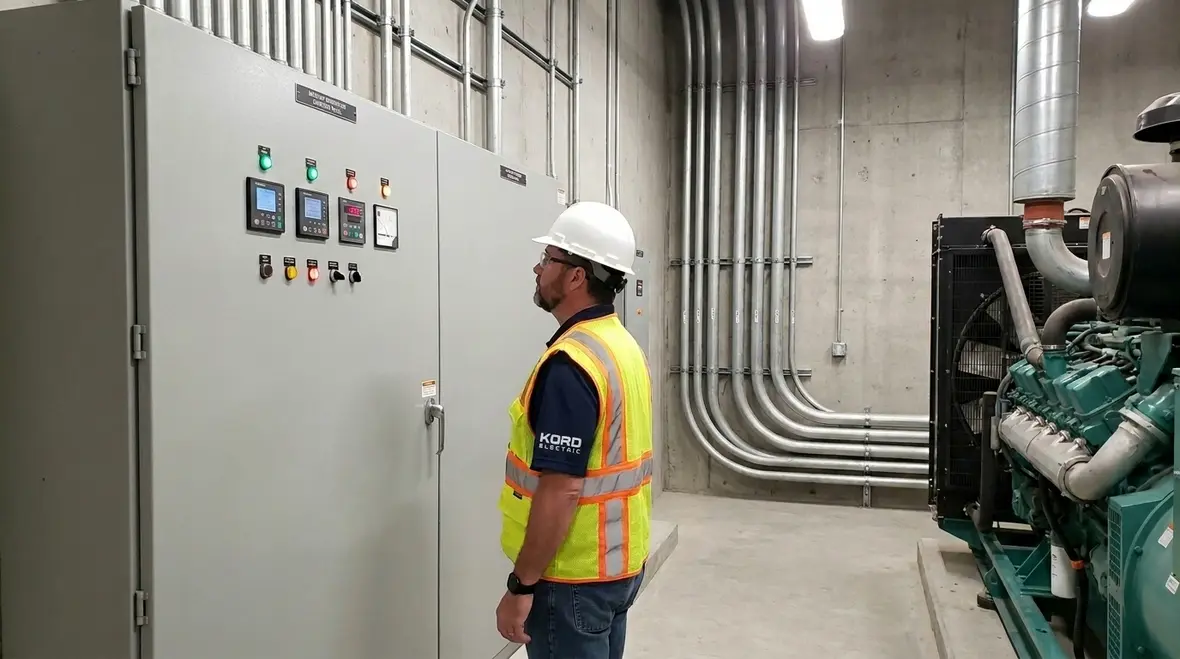
During planning, our team maps essential loads across operations, security, and life safety. Then we align the generator or power solution with the actual electrical demand profile. So, the business does not run on hope. It runs on design.
The same mindset also shows up in code and standards work. When you review how NFPA 70 covers emergency and backup power systems, you see that reliability is not optional background detail. It is baked into how safe commercial electrical systems are supposed to operate.
How fast transfer protects your equipment and people
Power loss is not just inconvenient. It can damage equipment and create safety risks. For example, abrupt shutdowns can affect sensitive controls, motors, drives, and process systems. In addition, ventilation interruptions can quickly turn from “annoying” into “unsafe,” depending on the facility type.
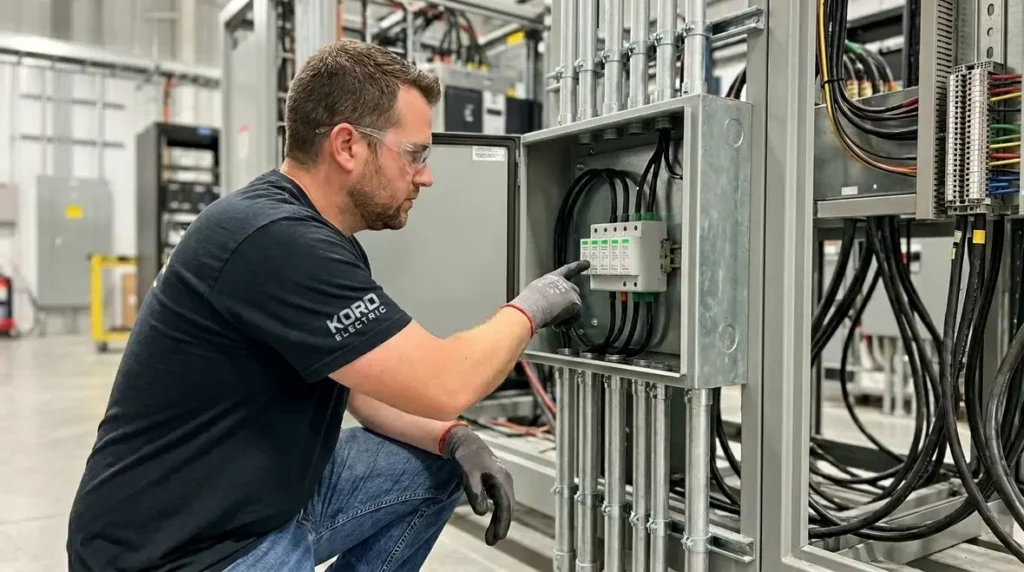
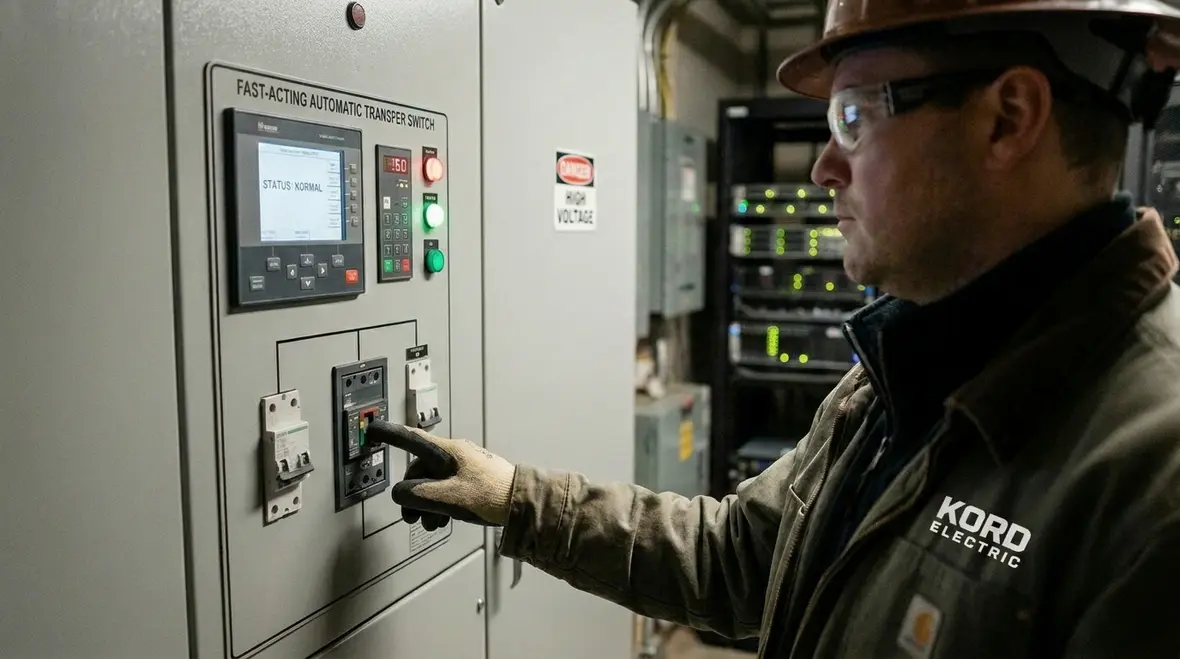
Kord Electric technicians focus on the transfer process, because the speed and method of switching matters. Proper transfer reduces stress on electrical equipment and helps critical systems remain stable. Moreover, when controls and monitoring integrate correctly, operations teams can follow clear steps instead of guessing.
We also remind clients of something people forget: modern facilities rely on more than “the lights.” They rely on consistent power for automation, communications, HVAC sequencing, and secure access. Therefore, transfer design supports both uptime and smooth recovery.
And yes, if you have ever watched a building restart like a computer running 40 browser tabs, you understand why this step counts.
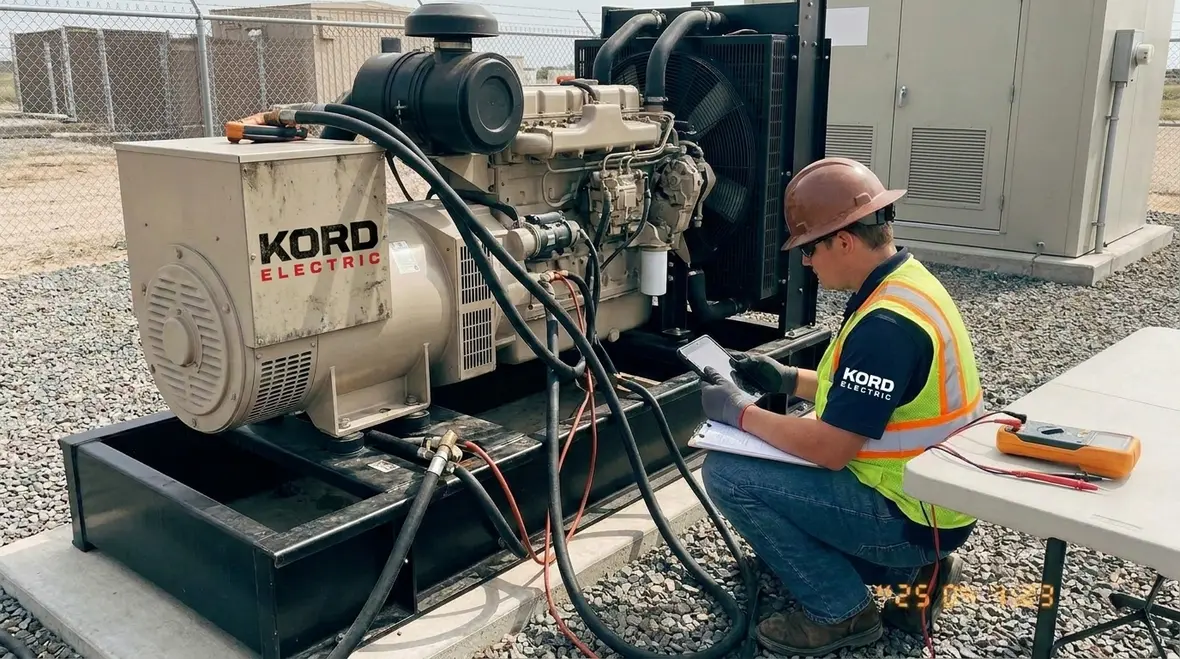
For facilities that have already seen confusing trips, flickering voltage, or inconsistent restarts after an outage, a focused look at voltage fluctuations in commercial and industrial buildings can highlight how transfer performance and voltage stability work together to protect equipment and keep operations calm.
Fuel, testing, and maintenance: where reliability is built
A generator can look impressive on paper, but real reliability shows up on service days. That is why we treat fuel management, load testing, and maintenance schedules as core parts of the emergency power strategy. Without them, the system might start, but it may not perform under the conditions the business needs.
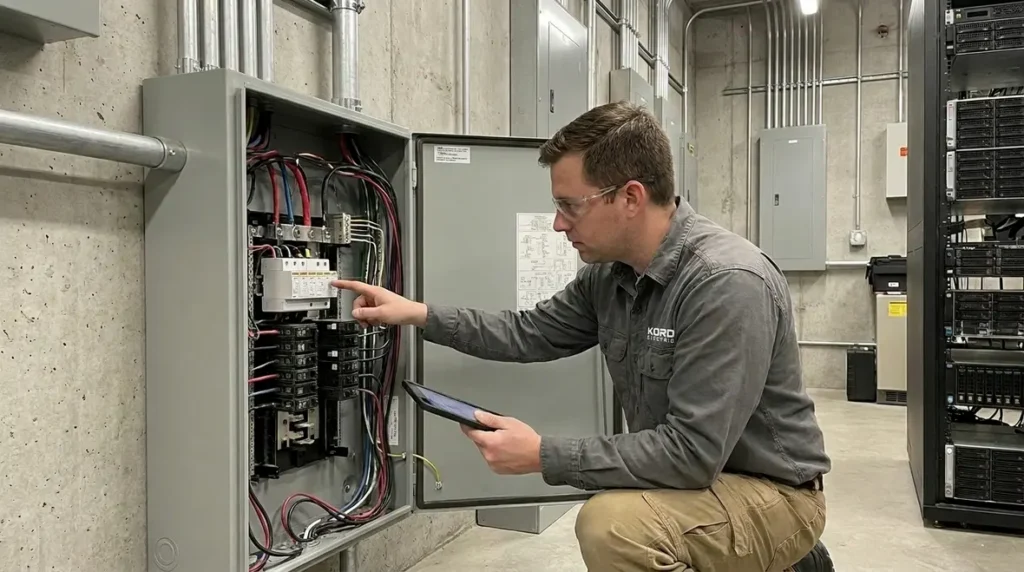
Our expert service staff helps commercial and industrial facility managers plan for real operating cycles, not ideal scenarios. We review fuel storage capacity, verify alarms and monitoring, and schedule tests that reflect actual load behavior. We also inspect transfer equipment and key components so issues do not hide until the next outage arrives.
In many cases, the biggest problem is that testing gets delayed because teams are busy. We understand that. Still, we advise clients that maintenance is cheaper than recovery. In fact, consistent testing can reveal weak points early, which keeps repairs smaller and prevents “surprise failures” that nobody budgets for.
Think of it like replacing the tires before the highway. No one likes the cost. Everyone likes arriving safely.
If your facility needs a structured way to keep that discipline in place, Kord Electric’s electrical preventive maintenance programs bundle generator and ATS inspections, infrared scans, and scheduled testing into one plan that supports emergency power business continuity instead of leaving it to chance.

Planning for risk: designing power for your actual loads
Every facility has a different definition of “critical.” A hospital campus does not share the same priorities as a warehouse, and a manufacturing line does not run like a mixed tenant office. That is why Kord Electric designs emergency power solutions around actual load groups and operational workflows.
First, we gather information about electrical demand, startup characteristics, and how equipment behaves during transitions. Then we build a strategy for what runs during an outage, what sheds load, and what stays safe. This approach helps prevent overloading and reduces the risk of partial operation that frustrates teams and slows recovery.
We also help clients align their plans with their maintenance capacity. A system can be technically strong and still fail in practice if it is too complex for the site’s operating habits. Therefore, we recommend clear processes for monitoring, response, and escalation.
When we do our work well, the business experiences fewer surprises. And when the lights return, systems restart with less chaos. That is a quiet win that leadership appreciates, even if they pretend they “love outages,” like it is a seasonal theme park.
For technically dense sites like data centers and production environments, it often helps to pair this planning with a distribution design for reliability or a data center electrical maintenance checklist, so emergency power decisions match the rest of the power architecture.
Staff readiness and response: the human side of continuity
Even the best emergency power system does not operate alone. People make it work. That is why our technicians do not just install and walk away. We help facility teams understand the system behavior, so they know what to expect during an outage and what to check during recovery.
In our experience, the difference between a manageable outage and a costly incident often comes down to clarity. Others may leave staff with confusing manuals and vague instructions. We keep training and explanation practical. Our expert service staff walks clients through key steps: alarms, transfer behavior, runtime expectations, and how to respond when the system indicates a fault.
We also help clients build a response routine that fits real shifts and responsibilities. When operations teams can act quickly and calmly, the facility protects safety, reduces downtime, and avoids extended recovery.
Because let’s be honest, during an outage, nobody wants to play electrical detective. They want the system to do what it is supposed to do.
Dual column considerations for decision makers
What teams measure during outages
Time to transfer and stable operation
Critical load performance during run time
Alarm clarity and escalation speed
Restart behavior and recovery steps
Safety system continuity
What Kord Electric designs and supports
Load mapping for true business priorities
Emergency power business continuity focused configuration
Transfer and control system checks
Testing plans matched to operational reality
Service support and technician guided explanations
FAQ
Next steps: protect your site before the next outage arrives
If your facility depends on uptime, you do not need a “maybe” plan, you need a tested, matched emergency power system and a team ready to explain it clearly. Kord Electric helps commercial and industrial buildings build reliable emergency power business continuity with design support, service, and technician guided readiness. Contact us to review your critical loads, discuss transfer and runtime needs, and schedule a maintenance and testing plan that keeps your operation steady. Let’s make outages boring for once.
If your site sits inside a busy metro footprint and juggles multiple tenant or operational demands, you can also look at how Kord Electric supports broader Los Angeles County electrical services to keep commercial and industrial properties aligned with both emergency power needs and day-to-day electrical reliability.
From hidden risks inside aging gear to the transfer sequence your team watches during every storm, treating emergency power as part of an integrated maintenance and reliability plan will always cost less than rebuilding trust after a preventable outage. Whether you are reviewing voltage stability, planning NFPA 70B-aligned maintenance, or building a new generator and ATS strategy from the ground up, Kord Electric can help you turn “we hope it works” into “we know what happens next.”