NFPA 70 Section 90.4 AHJ NEC Enforcement with Kord Electric
At Kord Electric, we work every day with a simple reality: safety rules only matter if they show up on site with an NEC enforcement authority having jurisdiction. That authority, often the AHJ, reviews plans, checks installations, and decides what corrections or approvals the facility needs. And when we say we do it “by the book,” we mean it. We follow the guidance tied to NFPA 70 Section 90.4 — NEC Enforcement and the AHJ, because the electrical system in a commercial or industrial property does not get to “wing it.” Neither do the people occupying the building, and honestly, nobody wants their sprinkler or critical power system to behave like a sitcom character who only shows up when convenient.
In the sections below, we explain how the AHJ enforces the National Electrical Code, what Section 90.4 is really doing, and how our expert service staff supports facilities across design, installation, inspection prep, and ongoing compliance. We will also keep it plain, so your team can make decisions without guessing.
What NFPA 70 Section 90.4 really means on a jobsite
NFPA 70, also called the NEC, sets practical electrical requirements for safe installations. However, Section 90.4 focuses on enforcement. In other words, it clarifies how the NEC functions in the real world: the code is adopted, interpreted, and enforced through the authority having jurisdiction. That authority may be a local building department, fire marshal, state agency, or another designated body.
Therefore, when an AHJ arrives, they do not treat the NEC like a suggestion written on the back of a napkin. Instead, they apply it in the context of the adopted code cycle, local amendments, and the specific conditions of the building. As a result, the same installation could face different documentation expectations in different jurisdictions. We see it often when commercial tenants move between cities or when a property upgrades equipment while the local adoption timeline changes.
And yes, we have heard the classic line: “The electrician said it was fine.” Meanwhile, the AHJ has a different definition of fine. That is why we prepare early and we document clearly, long before inspection day feels like a pop quiz.

How the AHJ interprets NEC requirements and handles enforcement authority having jurisdiction
The key point is that NEC enforcement authority having jurisdiction acts to ensure the installation meets the safety intent of the NEC and any adopted local rules. In practice, this means the AHJ may require plan clarifications, adjust inspection timing, or request field changes when something does not match the code language or the permit documents.
Importantly, the AHJ also considers “conditions” at the site. That includes how the building operates, the impact of an electrical fault, and how the system supports life safety or business continuity. For major property buildings, this often translates into extra scrutiny for circuits tied to emergency power, life safety equipment, standby systems, and equipment that affects occupancy.
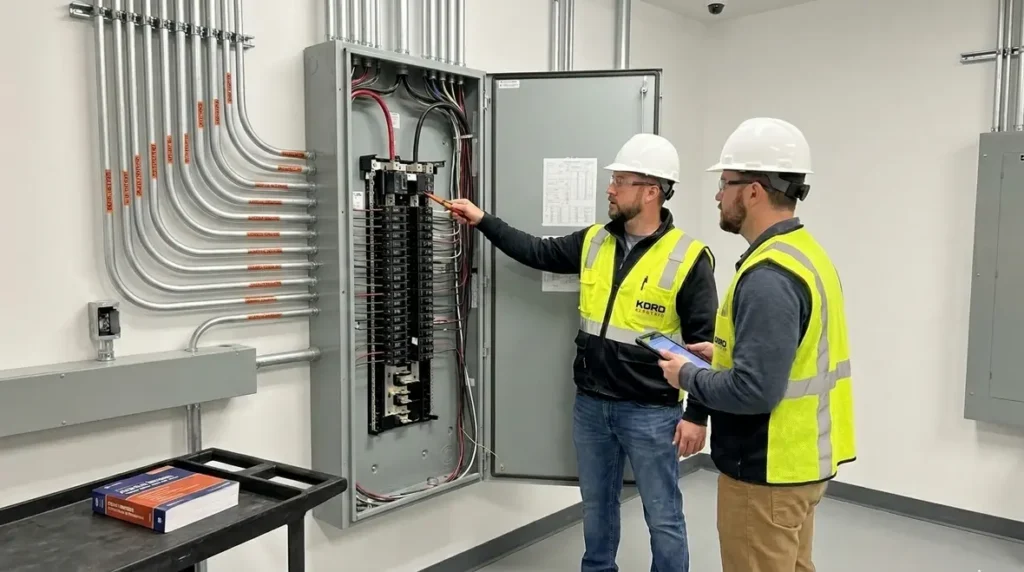
Our technicians and expert service staff explain the reasoning, not just the fix. We walk teams through what the AHJ typically looks for, how the code sections connect, and where documentation tends to matter. Then we help align design intent with what gets installed.
- During plan review: we assist with detail that supports compliance, such as labeling, verification notes, and coordination items
- During rough and final inspections: we prepare the facility team so nothing feels missing or improvised
- During field changes: we help manage updates in a way that keeps the permit and record set consistent

Why adopted code versions and local amendments change the outcome
Even though the NEC provides a baseline, many jurisdictions adopt with updates and sometimes add local amendments. Thus, the effective rules in your area can differ from the “default” version someone found online. That difference affects submittals, equipment acceptance, and how the AHJ documents approval.
Consequently, facilities that rely on outdated design assumptions can get pushed into rework. Rework is rarely about the electrical work itself. More often, it is about how the work ties to the jurisdiction’s current enforcement expectations.
This is where we support commercial and industrial facilities the right way: our approach reduces surprises. We coordinate with property leadership, contractors, and engineering teams so the compliance story stays consistent from permit through energization.
And if you are thinking, “Can’t we just call it close enough?” We get it. But close enough is how you end up paying for another round of testing, another round of labeling, or a delayed operational schedule. Nobody wins that game, least of all the facility manager trying to keep production running.
If your team wants a deeper dive into how NFPA 70 shapes those expectations, we also recommend reviewing the sister resource NFPA 70: All About The National Electrical Code (NEC) 2026 from Kord Fire, which explains why the code exists and how updates affect real facilities.
For teams mapping long term strategy, pairing this understanding with Kord Electric’s own article What Is NFPA 70? Understanding the National Electrical Code helps create a clear bridge between code concepts and practical design, especially as the 2026 direction shapes budgets and upgrade plans.
What inspections focus on under NFPA 70 Section 90.4
Section 90.4 sets the enforcement direction, and inspections reflect that reality. The AHJ typically focuses on whether the installation provides safe operation and avoids hazards like shock risk, fire spread, overheating, improper grounding, and incorrect wiring methods. However, inspections also look for completeness: proper documentation, required markings, and correct system configuration.
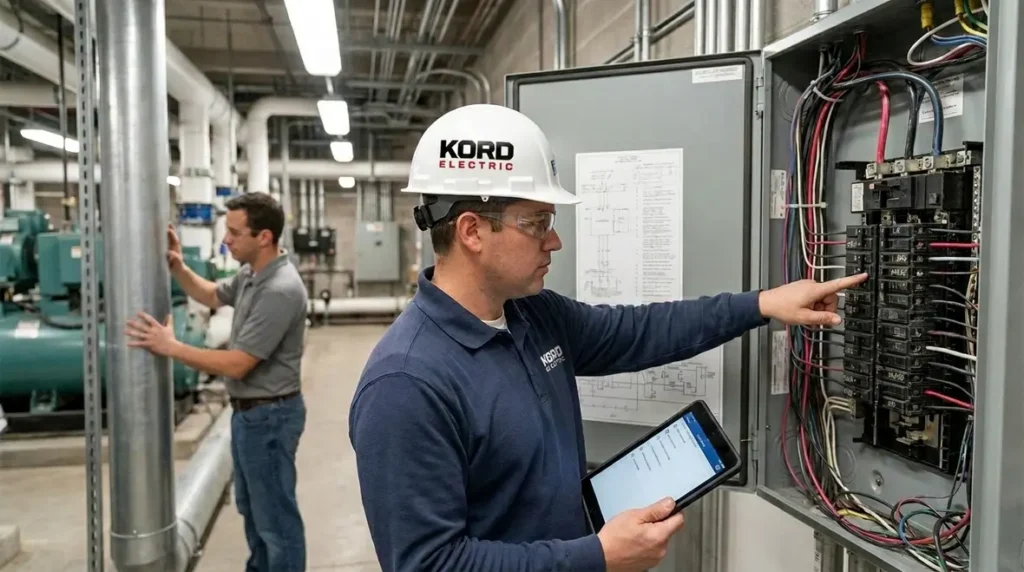
In major buildings, inspections frequently connect to systems that must function when normal power does not. That means emergency and standby arrangements, transfer equipment coordination, and protection methods. Therefore, you cannot treat those systems as “later.” Our technicians review the pathway from equipment to distribution, then from distribution to loads, with attention to how the facility will operate.
- Equipment protection and conductors: the AHJ expects conductor type, sizing, routing, and termination quality to match requirements
- Grounding and bonding: the inspection commonly checks for continuity, correct connection practices, and correct bonding intent
- Overcurrent protection and labeling: the AHJ checks protective device alignment with the circuit design and the labeling needed for safe operation
- System coordination: the AHJ may verify that protective devices and standby arrangements do not conflict with safety intent
To keep it calm and effective, we help facility teams understand what the inspection looks like before it happens. Our expert service staff does not just translate code lines; we show the field results those lines require.

How Kord Electric supports commercial and industrial compliance from permit to closeout
Kord Electric serves commercial and industrial facilities and major property buildings. We designed our process around the reality that compliance is not a single day event. It is a chain of decisions that begins in the planning stage and ends at closeout, with clear records and reliable field work.
So, we start with the “why” and then we move into the “how.” We also keep communication steady because code compliance fails quietly when teams assume someone else handled the details. We do not like that kind of surprise. We would rather handle it early, when changes still cost less and scheduling stays predictable.
When we work with property teams, we also consider how systems interact with building operations. For example, when critical power systems must remain stable, we coordinate around downtime needs and testing windows. That reduces the risk of last minute conflicts between electrical work, life safety requirements, and operational demands.
And if you are wondering how our broader resources connect, our company ecosystem includes Kord Fire materials that discuss NEC fundamentals and compliance topics. If you want a practical background, we encourage teams to review resources available through Kord Fire and related training sites like firepumps.org. It helps teams speak the same language when planning life safety and electrical systems.
For broader electrical strategy, many facility leaders also look at how these AHJ and NEC discussions connect with topics like Emergency Power for Business Continuity Design and Electrical Load Balancing for Commercial Power Reliability, since those systems often sit at the center of what inspectors review.
Common AHJ friction points and how our technicians help prevent them
Many compliance problems do not come from bad intentions. They come from missed details. And missed details, in the eyes of the NEC enforcement authority having jurisdiction, can still create hazards or create documentation gaps that delay approvals.
Here are friction points we commonly see on commercial and industrial projects, plus how we handle them:
- Missing or unclear documentation: we help ensure the submittal package matches the field work, including labeling and verification items
- Incorrect component selection: we verify that devices, fittings, and equipment support the installed conditions and meet the intended circuit requirements
- Field routing that conflicts with code expectations: we address routing plans early, so the installation matches what inspectors expect
- Bonding and grounding details: we check connections and installation practices so they remain consistent through rough and final stages
- Standby and emergency coordination issues: we help teams maintain system logic and safe switching behavior, not just wiring continuity
Now, to lighten the mood, we once joked that paperwork is the “season finale” everyone forgets to watch. Then the AHJ asked for the missing page, and our joke stopped being funny. That is why our expert service staff keeps compliance documentation organized from the start, not at the end.
Because documentation, inspections, and long term performance are linked, many property teams also pair our AHJ-focused support with structured reliability planning, such as the guidance in Electrical Preventive Maintenance Schedule Guide and Data Center Power Quality for Reliable Uptime. When the power quality and maintenance story are strong, AHJ conversations typically get easier.
FAQ: NEC enforcement, AHJ expectations, and practical compliance
Next steps with Kord Electric
If you manage a commercial or industrial facility, you do not need guesswork. You need a compliance plan that matches how the AHJ enforces the NEC, including the intent behind NFPA 70 Section 90.4. Our technicians and expert service staff help you prepare early, document clearly, and install correctly so approvals move faster and operations stay stable. Call Kord Electric to review your upcoming work, inspection risks, and closeout needs, and we will help you keep the lights on and the compliance solid.
When you are planning broader electrical upgrades or reliability work across Los Angeles County and surrounding areas, our dedicated Los Angeles County electrical services for commercial and industrial facilities connect these NEC and AHJ requirements with practical project delivery, from new installations and retrofits to preventive maintenance and emergency power planning.
If you want to keep reading while you plan, the Understanding NFPA 70, the National Electrical Code Explained for 2026 article on the Kord Electric blog expands on how upcoming code direction influences long range planning, budgets, and coordination with the NEC enforcement authority having jurisdiction.