
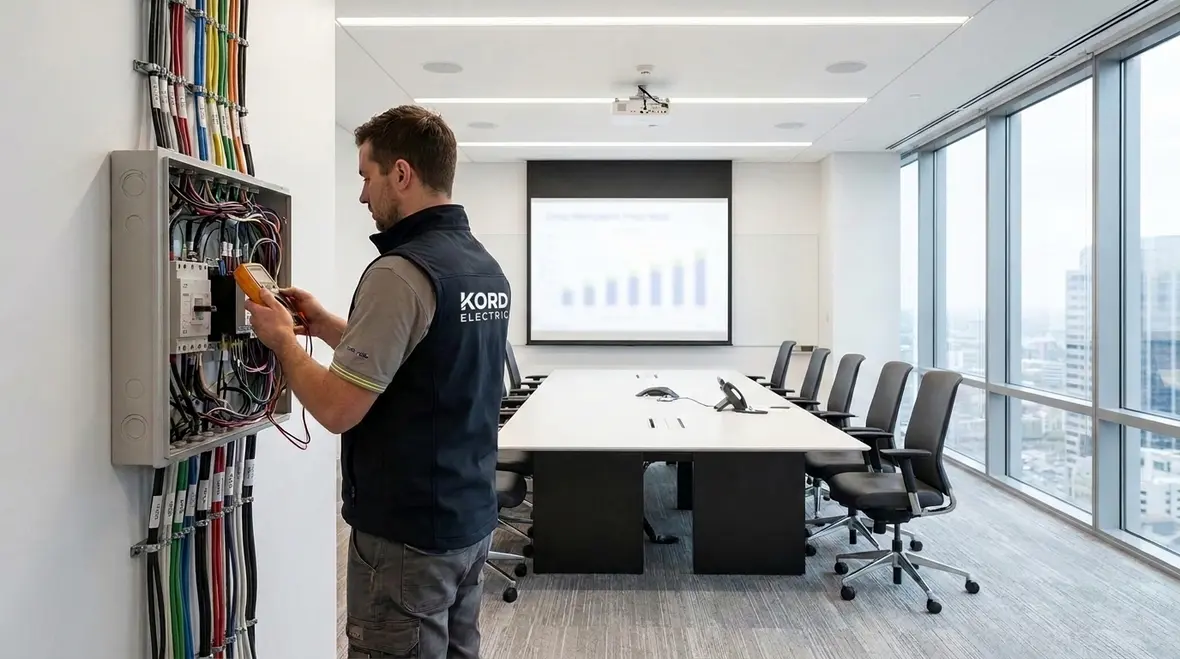
NEC Meeting Room Branch Circuits 210.65 Compliance
In commercial and industrial spaces, the way we wire NEC meeting room branch circuits matters more than most people expect. In fact, it often decides whether a room stays powered during a busy meeting, a training session, or an emergency shutdown drill. When the lights dim at the exact wrong moment, everyone suddenly becomes an expert in electrical troubleshooting. At Kord Electric, we guide property owners, managers, and electrical decision makers through the real intent of NFPA 70 Section 210.65 for meeting room branch circuits, so installations support safety and reliability, not just code boxes on a checklist. And yes, we can explain it in plain language, because our technicians do not believe customers should need a decoder ring to understand wiring.
If your team wants a broader grounding in how NFPA 70 shapes these decisions, you can also connect this topic to resources like Kord Fire’s overview in NFPA 70: All About The National Electrical Code (NEC) and Kord Electric’s own guide Understanding NFPA 70: The National Electrical Code Explained For 2026, which help connect big picture code themes to real project planning.
NFPA 70 Section 210.65 and meeting rooms in commercial buildings
NFPA 70, also known as the National Electrical Code, sets rules that help keep electrical systems safe and predictable. Section 210.65 specifically addresses branch circuits that feed meeting rooms. In commercial and industrial facilities, meeting rooms often sit inside larger buildings where power demand changes fast. Therefore, the code focuses on how those circuits supply load in a way that reduces risk and improves performance during both normal operation and fault conditions.
As we review a site, our expert service staff looks at how the room gets used. For example, meeting spaces may host audiovisual gear, laptops, charging stations, projectors, and sometimes temporary stage power. Even if the room looks simple, the wiring must handle real usage patterns. Next, we map how the circuits connect, then we confirm the design supports code intent for safety and practicality.
Of course, we also remind people that electricity does not care about meeting schedules. It shows up when it is ready. We show up when you are ready, because that is the job.
What NEC meeting room branch circuits must accomplish
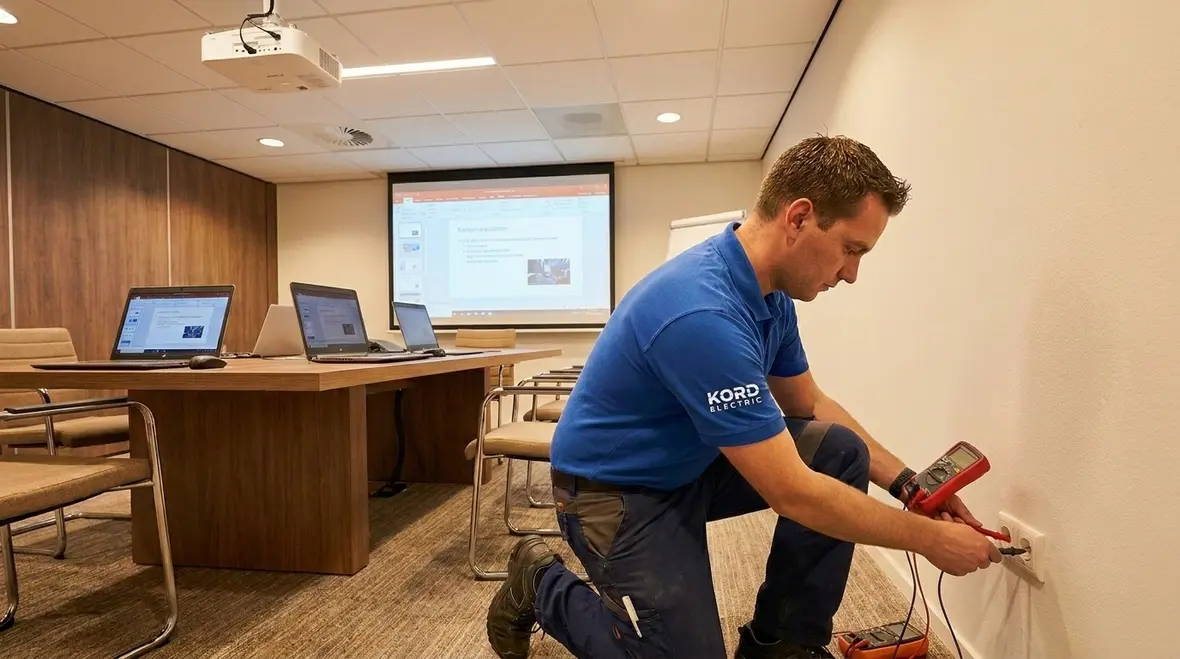
Meeting room branch circuits exist to do a few important things. First, they supply the outlets and loads the room needs without overloading or creating unsafe conditions. Second, they help ensure that the protection devices work as intended, meaning they trip when they should and remain steady when they should. Finally, they support layout requirements that make the wiring practical for ongoing use and upgrades.
When our technicians evaluate a facility, they do not stop at the minimum. They consider how the electrical system behaves over time. For instance, older buildings often have patchwork modifications. One upgrade might add receptacles, while another move might reroute conductors. Over time, this can create confusing circuit identification and uneven load sharing. Therefore, we verify conductor sizing, circuit arrangement, and panel organization, so you get a setup that stays manageable even when the building changes.
And if you think this sounds like “electrical grown up talk,” you are right. The code is written for the real world, not for fantasy power point slides.
For facilities that want to zoom out and see how meeting room circuits sit inside the larger branch circuit picture, companion topics like NEC branch circuit identification for safer commercial systems and NEC branch circuit voltage limitations in NFPA 70 210.6 from the Kord Electric Blog can help round out planning conversations.
How we apply circuit requirements during design and upgrades
In a commercial or industrial project, we typically enter the story at one of two points. Sometimes we help with new construction. Other times we step in for upgrades, renovations, or tenant improvements. Either way, our process stays consistent: we collect the design intent, review the floor layout, then we confirm how the branch circuits will feed the meeting room areas.
We begin by checking the electrical one line diagram and the planned outlet locations. Then we verify that the circuit design aligns with the meeting room branch circuit needs in NFPA 70. After that, we validate proper protective device ratings and conductor capacity. Next, we confirm that the physical routing supports safe installation practices, including proper support, segregation from hazards when needed, and reliable termination methods.
From there, we also plan for maintenance. In real buildings, people will eventually ask questions like, “Which breaker powers that wall outlet?” We avoid mystery by keeping labeling clear and by organizing panels so others can service the system without guessing.
Our expert service staff explains these steps as we go, because when clients understand the “why,” approvals move faster. And honestly, that is a lot better than waiting for a late night call that starts with, “We flipped the breaker and it didn’t fix anything.”

Because meeting rooms typically live inside a broader electrical network, our design and upgrade work also ties into code strategy topics like electrical infrastructure upgrade planning for commercial facilities and electrical code upgrade consulting for renovations, which help facility teams phase improvements without disrupting operations.
Outlet placement, load balance, and avoiding nuisance power issues
Meeting rooms can feel calm, until you add equipment. When a room runs video displays, audio systems, and charging, the load becomes more than lighting. Therefore, a correct meeting room branch circuit strategy helps distribute demand and reduces nuisance trips.
We often see the same problems during inspections and troubleshooting. Sometimes the receptacles get added later without a circuit plan. Other times the panel schedule does not match reality. As a result, one circuit can end up doing too much work, while another sits underused. Then, when someone plugs in multiple devices during a training, the circuit protection may trip, or the system may operate outside what it should.
To prevent that, our technicians look at expected use. They also ask practical questions about how the space works day to day. Then we align the circuit arrangement with the design needs, so the room stays ready for the next meeting, not the next emergency call.
In pop culture terms, you do not want your electrical system to be like a sitcom character who always breaks at the worst time. We prefer a smooth, steady performance, the kind that does not need a laugh track.
Connecting outlet strategy to broader NEC branch circuit rules
Outlets are where people notice problems, but the real story often starts with how the NEC meeting room branch circuits tie into upstream decisions. Topics like NEC branch circuit identification, branch circuit voltage limitations, and multiwire branch circuit rules all influence how reliable those meeting rooms feel during real use. Planning these details on purpose also makes it easier for your team to understand NEC meeting room branch circuits usage when you expand or reconfigure spaces later.
Keeping safety and reliability aligned with major property standards
Commercial and industrial buildings do not only need code compliance. They need reliability that supports operations. NFPA 70 rules aim to protect people and property, and that includes how branch circuits perform. When those rules get implemented well, facilities reduce shock risks, reduce fire risks, and improve how the system responds to faults.
For major property buildings, the bigger challenge often comes from coordination. We might work with architects, general contractors, fire alarm teams, and facility managers. Therefore, we confirm electrical interfaces early, including how the meeting room spaces integrate with the building’s broader power distribution.
That is also where our team’s communication style matters. We explain the reasoning behind each decision. We do not drown clients in jargon. Instead, our expert service staff walks through how the circuits tie into panel protection, how outlets will behave under typical load, and how the design supports safe operation during abnormal conditions.
And when a client says, “We just want it to work,” we smile and say, “Then let us build it the way that makes it work on purpose.”
How fire protection and electrical planning intersect
Meeting room branch circuits might seem far from fire pumps or suppression systems, but the same philosophy drives all of it: protect people, protect property, and keep systems ready when the unexpected happens. That is why Kord Electric often coordinates with Kord Fire resources and NFPA driven content so that electrical, life safety, and fire protection all pull in the same direction instead of competing for space in the ceiling or in the schedule.
Service approach in commercial and industrial facilities
Kord Electric focuses on commercial and industrial facilities and major property buildings. That focus shapes how we plan and deliver electrical work. We do not treat meeting room electrical systems like a one off residential job. Instead, we treat them as part of a larger, mission critical network that supports staff, tenants, customers, and visitors.
To make that real, we bring structured field practices. We verify that installation methods meet code expectations, we confirm labeling and documentation, and we test where testing applies. Then we hand over information that facility teams can use later. In other words, we help you keep control after the project closes out.
We also coordinate with fire and life safety expectations, because an electrical system cannot be separated from life safety planning. If you work with fire protection teams and want to understand the NEC from a broader viewpoint, Kord Fire resources can help you connect the dots on NFPA 70 basics and how the code fits into fire related thinking.
Dual Column Summary
What our technicians verify | Why it protects your facility |
Conductor sizing, circuit protection, and outlet circuit arrangement | Supports safe performance and reduces overheating or nuisance trips |
Panel organization and accurate circuit identification | Improves maintenance response and reduces operational confusion |
Installation practices and terminations | Builds reliability that holds up under real building use |
Because these checkpoints tie directly into uptime and safety, they also connect naturally to maintenance strategies like those in NFPA 70B electrical panels and switchgear maintenance, where disciplined inspections keep NEC meeting room branch circuits performing the way they were designed.
Featured FAQ for meeting room branch circuit compliance
Call Kord Electric before the next meeting turns into a troubleshooting session
If your building has meeting rooms that feel unpredictable, Kord Electric can help you bring electrical performance back under control. Our technicians and expert service staff review design intent, verify circuit protection, and confirm outlet circuit arrangements in commercial and industrial facilities. Then we explain what we find in clear terms, so your team can make confident decisions. Contact Kord Electric today for an assessment and a practical plan that supports safety, reliability, and smooth operations. Your next meeting should start on time, with lights that behave.
For facilities across the region, our team also delivers full service support through our dedicated Los Angeles County electrical services, so your NEC meeting room branch circuits, panels, and distribution all benefit from experienced crews who understand how commercial work really runs.


